Ask The Collective

ASK A QUESTION AND GET A HUMAN ANSWER

Ask anything about black and white photography. Gear, light, composition, editing, printing, or how to see. Every answer here comes from a photographer rather than a machine, and it is signed with their name. We’ll share our thoughts, and anyone in the collective is welcome to add their own answer. You don’t need an account to ask.

Ask a question

Your email is never shown on the site. We use it to let you know when somebody answers.

One photograph, JPEG, PNG or WebP, up to 8 MB.

Pinned Seeing and practice

How do you train yourself to see in black and white?

How do you train yourself to see in black and white rather than shooting in color and converting afterwards? I want to recognize the picture before I take it.

It’s a very personal thing. I knew a woman who used sunglasses to remove the color from the scene. Personally I have just looked for light and shadow and texture and ignored the colour. It might be easier for me though because I am shade colour blind – blue and black are essentially the same to me.

The sunglasses idea is really interesting. I would be curious to use them without a camera in my hand and just observe the world. I think that would train the eye.

I’ve seen somebody using a yellow filter mounted into a monocular but personally I found it unnecessary after you train a bit in directly seeing in monochrome

Light and exposure

Why do my overcast day photos come out flat?

Why do my overcast day photos come out flat and lifeless? The light looked beautiful when I was standing there, soft and even, but the pictures are a wall of middle gray.

I think you might have answered the question yourself by saying the light was soft and even so minimising contrast, I assume you are shooting RAW so its down to you in processing to add the depth to your images, Curves will be your friend, they can be a powerful localised adjustment depending on how you use them. Also using the time honoured "dodge and burn" technique will most surely help. Don't be afraid to move the sliders and think local rather than universal. Apart from processing you might need to check your camera settings particularly the type of metering you use.

Composition

In this photo, I decided to focus in on the end point where the…

In this photo, I decided to focus in on the end point where the person is. I think the placement is good. The question I have is about the sides. Does this composition work with the left side having the angle? Should I have shot the scene differently? Not sure symmetry would even be an option.
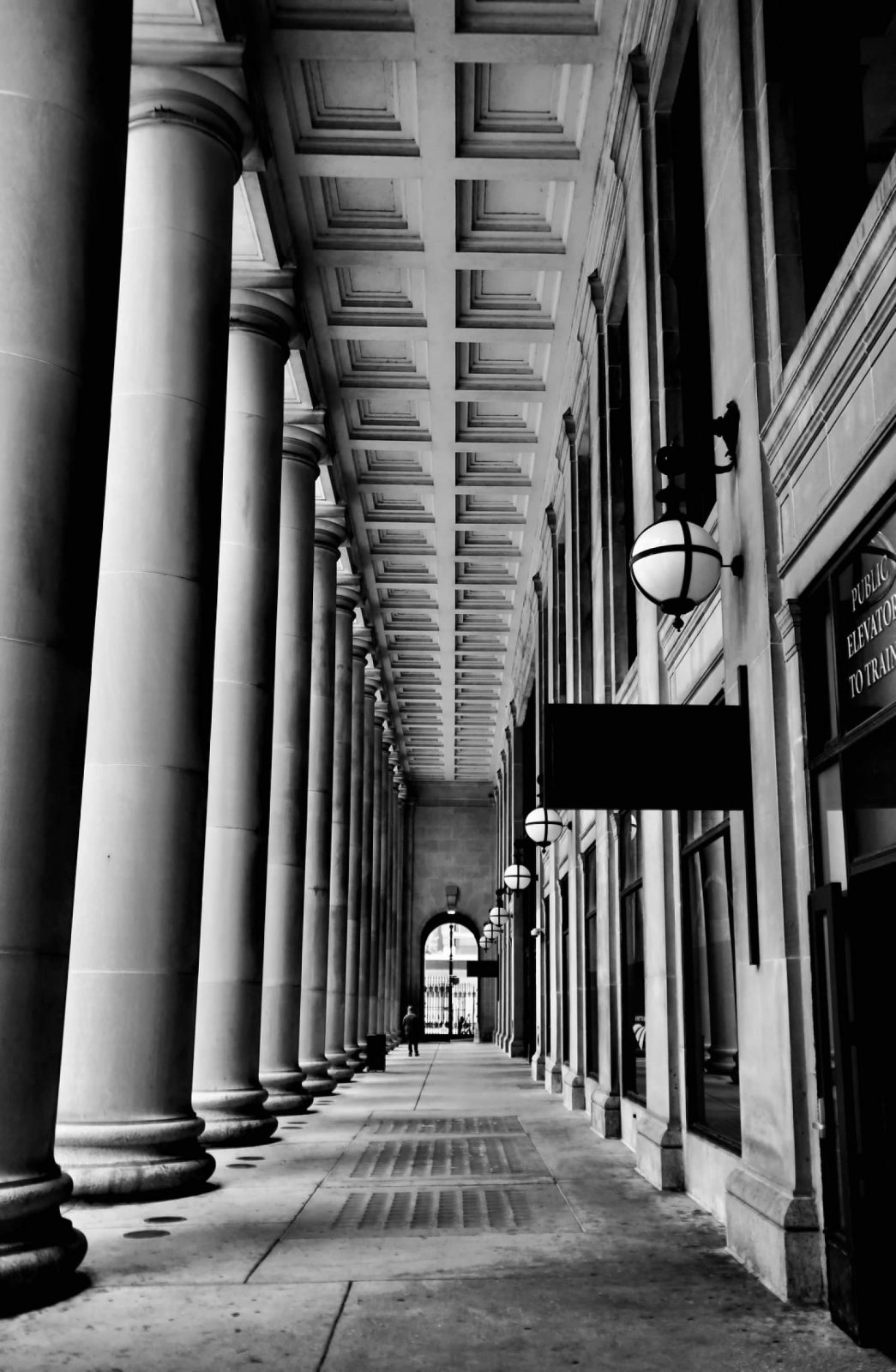
Image added by Elizabeth

Hey Elizabeth. This is a great image. I love the architecture and I like the leading lines and repeating pattern of the columns. I’m not sure what you mean by the angle on the left, were you talking about the perspective? If so, you could easily use perspective correction in Lightroom or capture one. As far as the overall composition just to give a few things to think about. I like the human figure in this image, and I think if the person moved slightly to the right, you would see more of their silhouette against the overexposed area and still retain the side light hitting the person through the columns. Another thing to think about is the large black sign in the foreground of the image. Possibly taking a couple steps forward, may have eliminated the sign and not change the overall composition. It would have moved you slightly closer to the person and changed their size relative to the overall composition, but I think it still would have worked. Composition is all about making choices and I think you made some really good ones here. It’s a strong image.

Thank you so much! This is such helpful feedback! I hadn’t considered the sign. I usually look at the foreground but got caught up on the long view. Appreciate your input.

Printing

Matte or gloss, and what paper should I start with?

What paper should I start with for black and white, and does matte or gloss suit it better? I’ve been buying a different pack every time and I’m getting nowhere.

I think that really depends on how you wanted to display the print. Behind glass, gloss can pick up reflections that might hinder the look and feel of the image. However, I really do like gloss. I think the best way to answer your question is to print an image both Matte and Gloss frame it behind glass and see which one you like better.

Other

Is it wrong to shoot in both black and white and color?

Is it wrong to shoot in both black and white and color? As an amateur, I love to do both and feel there are images that just work better in color. I think this is part of a bigger challenge I have of not narrowing into a single genre.

Hey Elizabeth, it's definitely not wrong. There are no rules for that and even the established rules are made to be broken at times. What I find helpful is to be deliberate about shooting color vs B&W. For myself it helps because I look and see things differently when I'm focused on one or the other. It simplifies my focus. It seems like many photographers decide on B&W later as an after thought but that limits what you could have seen or what you may have missed if you were completely focused on B&W while shooting. Hopefully that makes sense.

I agree with this. I think I need to be more deliberate about it for a whole session. If I am out on the street and practicing there, I find there are images that could work in color and some that are B&W and for me, that can change along a single city block. Thank you for this reply.

Composition

How do you decide a photo should be black and white before you shoot?

How do you decide a scene should be black and white before you press the shutter rather than afterwards? I keep shooting in color and then trying conversions to see what works, which feels backwards.

Personally I don’t decide that.

My camera is set to black and white mode, which shows a black and white image on my LCD screen, and I shoot with an optical viewfinder. When my raw files are imported into Capture One they’re automatically converted to black and white, so I don’t even see the color in my images.

Gear

Does a monochrome sensor give you something a conversion can’t?

Does a dedicated monochrome sensor actually give you something you can’t get by converting a color file? I keep reading that they’re sharper and cleaner, and I’m trying to work out whether it’s worth the money and losing color for good.

Honestly, I think the benefits are negligible.

The argument you usually hear is that a monochrome sensor has no low pass filter, which gives you more micro contrast and sharpness. But not all color sensor cameras have one either. My own Leica M11 does not.

Editing

Why does my black and white conversion look muddy?

Why does my black and white conversion look muddy compared to the color file I started with? Nothing is wrong with it exactly, it just sits there looking dull.

The obvious answer is lack of contrast, but not the kind controlled by a slider in Lightroom or Capture One. It’s a problem with natural contrast.

When you look at a scene you should be looking for natural contrast. Training your eye to see tonally, using the histogram, and changing your viewfinder or LCD to black and white can all help.