Elliott Erwitt summed it up in a single line. The surprise is that he spent much of his working life shooting in color.
“Color is descriptive. Black and white is interpretive.” Elliott Erwitt, the Magnum photographer best known for his dogs, his humor and his eye for the absurd, put it that plainly, and black and white photographers have been quoting him ever since. It is one of those lines that sounds obviously true the first time we hear it. It is worth slowing down on, though, because what it actually asks of our work is more demanding than it first appears.
Color tells us what was there
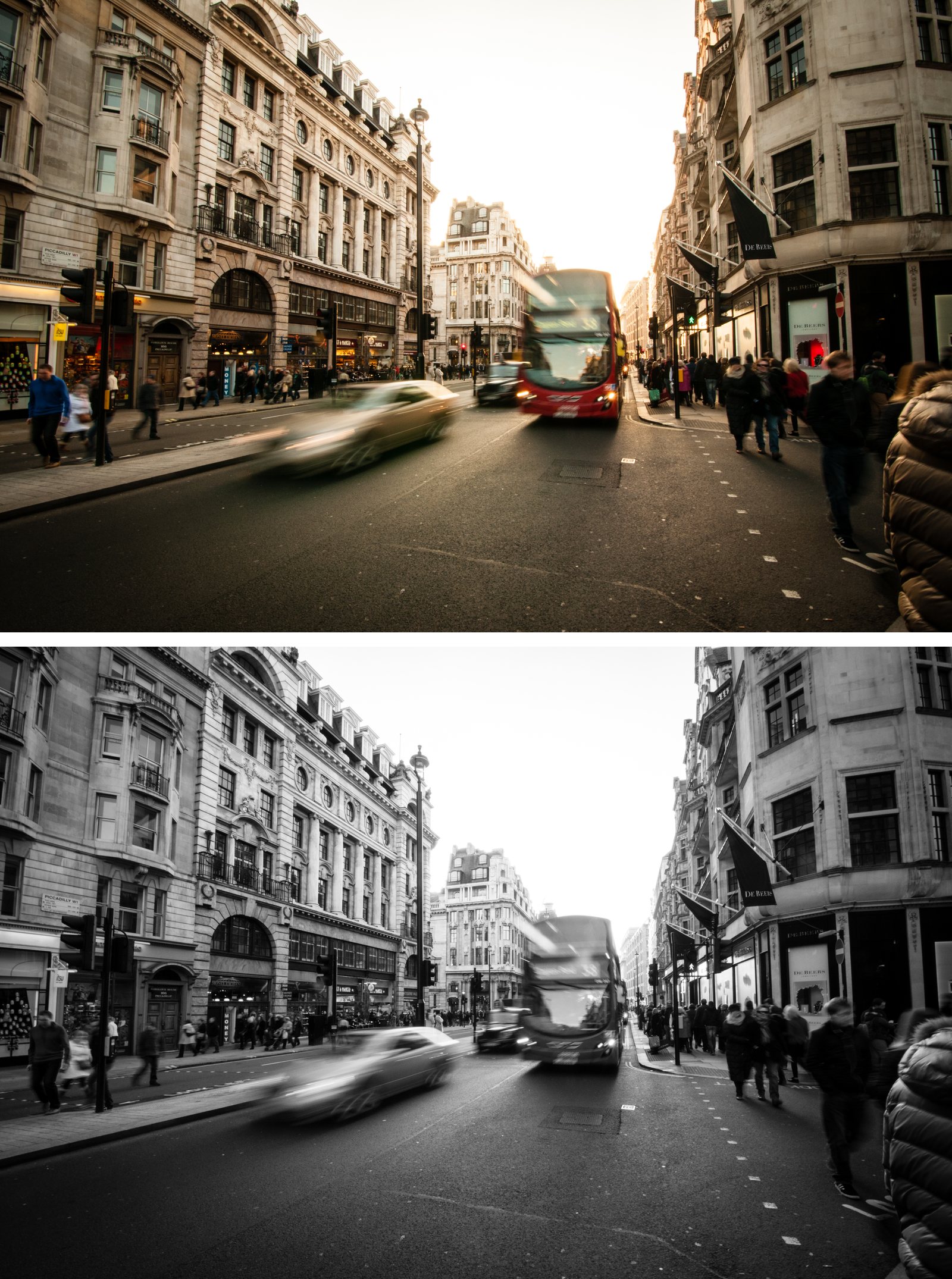
Color is very good at facts. It tells us the car was red, the leaves had turned, the light was the gold of late afternoon and the sign belonged to one particular shop. A color photograph answers the question of what the scene looked like, and it answers with a kind of authority, because color is how we actually saw the moment. That is what Erwitt meant by descriptive. In that sense color reports, and it reports well.
That is not a weakness. A great deal of photography needs exactly that. A product has to be the right shade, a news photograph has to show what happened, and a family picture has to show the blue dress she really wore. Description is a genuine and useful thing for a photograph to do, and nobody should feel embarrassed about wanting it.
Nobody has ever seen the world in gray
Black and white cannot do that job, and that is the whole point. Nobody walking down a street sees it in shades of gray, so the moment a photograph gives up color, it stops claiming to show the scene the way it looked. It becomes openly a version of the scene, one person’s reading of where the light fell and what mattered. Viewers sense that without thinking about it, and they look at a black and white photograph a little differently because of it, less as a record and more as a statement.
That interpretation happens twice. It happens when we make the photograph, deciding which colors become which grays, and whether a red door and a green hedge pull apart or melt into the same tone. Then it happens again when someone looks at the picture and fills in what the gray leaves open, the color of a coat, the temperature of the air, the time of year. A black and white photograph asks more of both people, and it gives both of them more room.
The man who said it made his living in color
The part of the story that usually gets left out is who said it and when. As an account of his book Elliott Erwitt’s Kolor explains, Erwitt shot his commercial and advertising assignments largely in color and kept black and white for the personal work he thought of as his own. That book draws on close to half a million Kodachrome slides made over some seventy years.
That changes how the line reads. It is not a ranking, with black and white on top and color underneath. It is closer to a job description. When a client needed the world shown accurately, color did that work. When Erwitt wanted to say something about the world, he reached for black and white. Seen that way, the real question is not which one is better, but which job a particular photograph is actually doing.
Converting a photograph does not make it interpretive
This is where the quote starts asking something of us. It is easy to hear that black and white is interpretive and assume that converting a picture turns it into interpretation. It does not. A straight conversion with no decisions behind it simply describes the scene in gray, which is description with less information rather than interpretation. What makes a black and white photograph interpretive is the choices, where the deepest dark sits, what is allowed to fall away into shadow, and which shape the eye finds first.
Worth being honest in the other direction too. Color can be deeply interpretive in the right hands. Saul Leiter and William Eggleston used color as a point of view rather than a record, and their photographs say as much about how they saw as about what was in front of them. Erwitt’s line describes what each medium does by default, not what it is limited to.
So the quote turns out to be less a compliment to black and white than a responsibility, because color will describe the world whether we make any decisions or not, while black and white only interprets when someone is genuinely doing the interpreting. The gray is not the point of view. We are.