Nobody has ever actually seen a hunter in the night sky. People have been seeing Orion for thousands of years anyway.
Look up on a clear winter night and there he is, a hunter with a belt of three stars and a raised arm. There are no lines up there, of course, and no hunter. There are just dots of light at wildly different distances that happen to sit near each other from where we stand. Our minds do the rest, joining the dots and turning scattered points into a figure we recognize. That instinct to find a whole shape in a scatter of parts has a name, and it explains a great deal about why some black and white photographs work and others simply do not.
A theory about seeing the whole first
It is called Gestalt psychology, from the German word for shape or form. It began in Germany in 1912, when Max Wertheimer published a study of why lights flashing one after another appear to move, working alongside two other psychologists, Wolfgang Köhler and Kurt Koffka. Their big idea was that we do not see the world piece by piece and then add it up. The mind organizes what it sees into wholes straight away, because taking in thousands of separate details one at a time would be overwhelming.
The famous summary of it is usually quoted as “the whole is greater than the sum of its parts,” but that is not quite what Koffka said, and he actually disliked that version. His point was that the whole is something else, something different from the parts added together. A constellation is not more stars than we see. It is a different thing altogether, a shape that only exists because our minds made it.
Why it matters more without color
In a color photograph the brain has an easy way to sort things, because a red coat and a green hedge are obviously separate. Take color away and that shortcut is gone. All that is left for the mind to organize with is tone, shape and where things sit in the frame, so the ways it groups and separates what it sees end up doing almost all of the work. That is genuinely good news for black and white photographers, because tone, shape and where we place things in the frame are exactly what we control.
The star and the sky around it
Before anything else, the mind decides what the subject is and what is simply behind it, the figure and the ground. In the night sky it is effortless, bright points against black. In a photograph it is not always so easy, and in black and white that decision is made almost entirely by tone. A dark figure against a light wall separates instantly. A dark figure against a dark doorway can vanish, which is why testing a frame as a few simple dark and light shapes tells us so much.
Stars that belong together
The three stars of Orion’s belt read as one thing because they sit close together, and the brightest stars of the constellation read as one shape because they look alike. Gestalt calls these proximity and similarity, and they work the same way in a photograph. People standing close together read as a group rather than as separate people. Things that share a tone, a shape or a size seem to belong together, even when they are nowhere near each other, which in black and white means a pale face and a pale window on the far side of the frame can quietly start talking to each other.
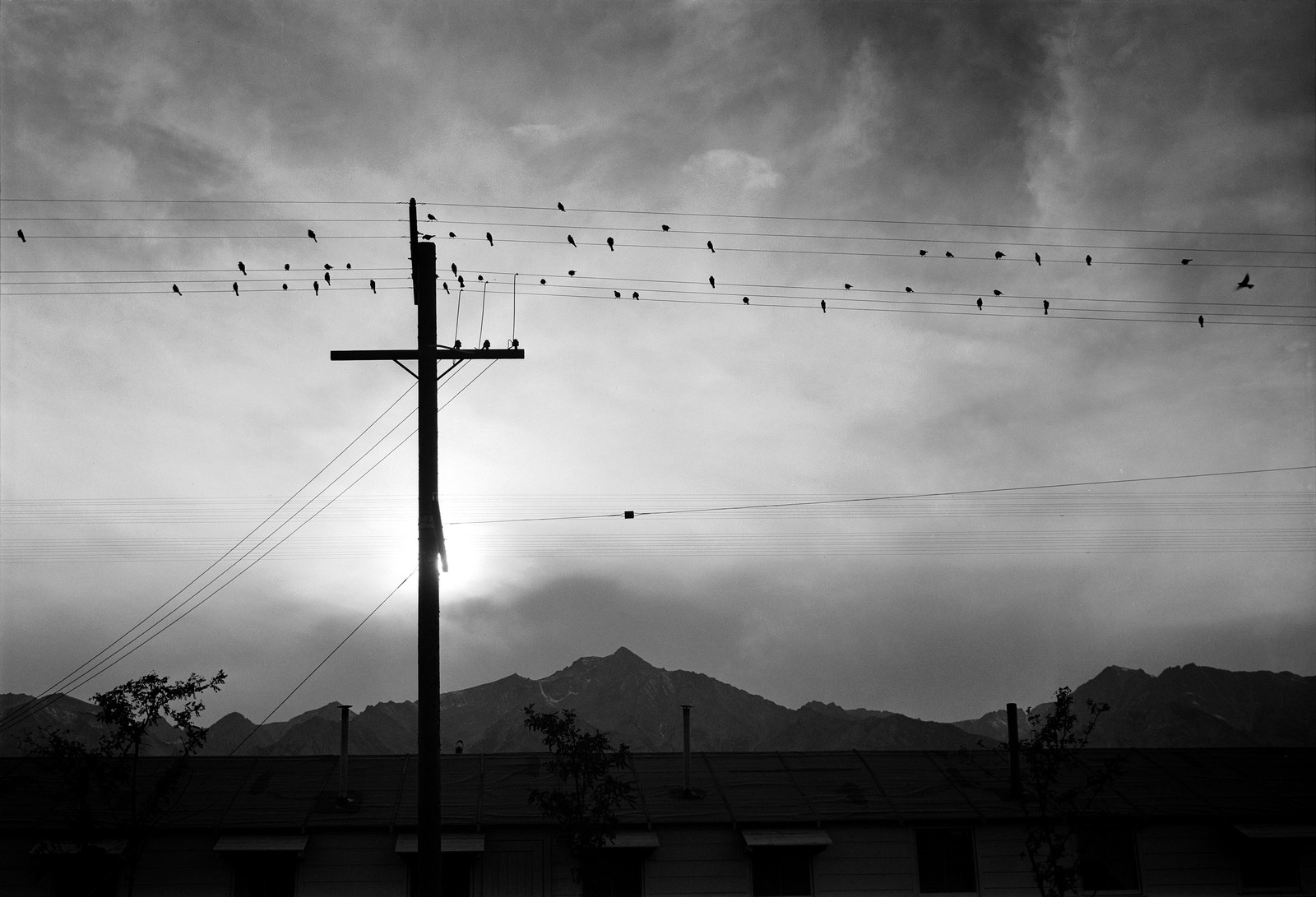
Ansel Adams’ photograph of birds on the wires at Manzanar is a good example. There are dozens of separate birds in it, but we do not count them. Close together and all the same dark shape, they read as a pattern strung across the sky, and that pattern is what the picture is about.
The lines that are not really there
Nobody drew the lines between the stars of Orion. We add them ourselves, and that habit of finishing a shape that is only suggested is called closure. The drawing below makes the point better than words can. There is no white triangle in it, just three black circles with slices cut out and a few angled lines, yet almost everyone sees a bright triangle sitting on top.
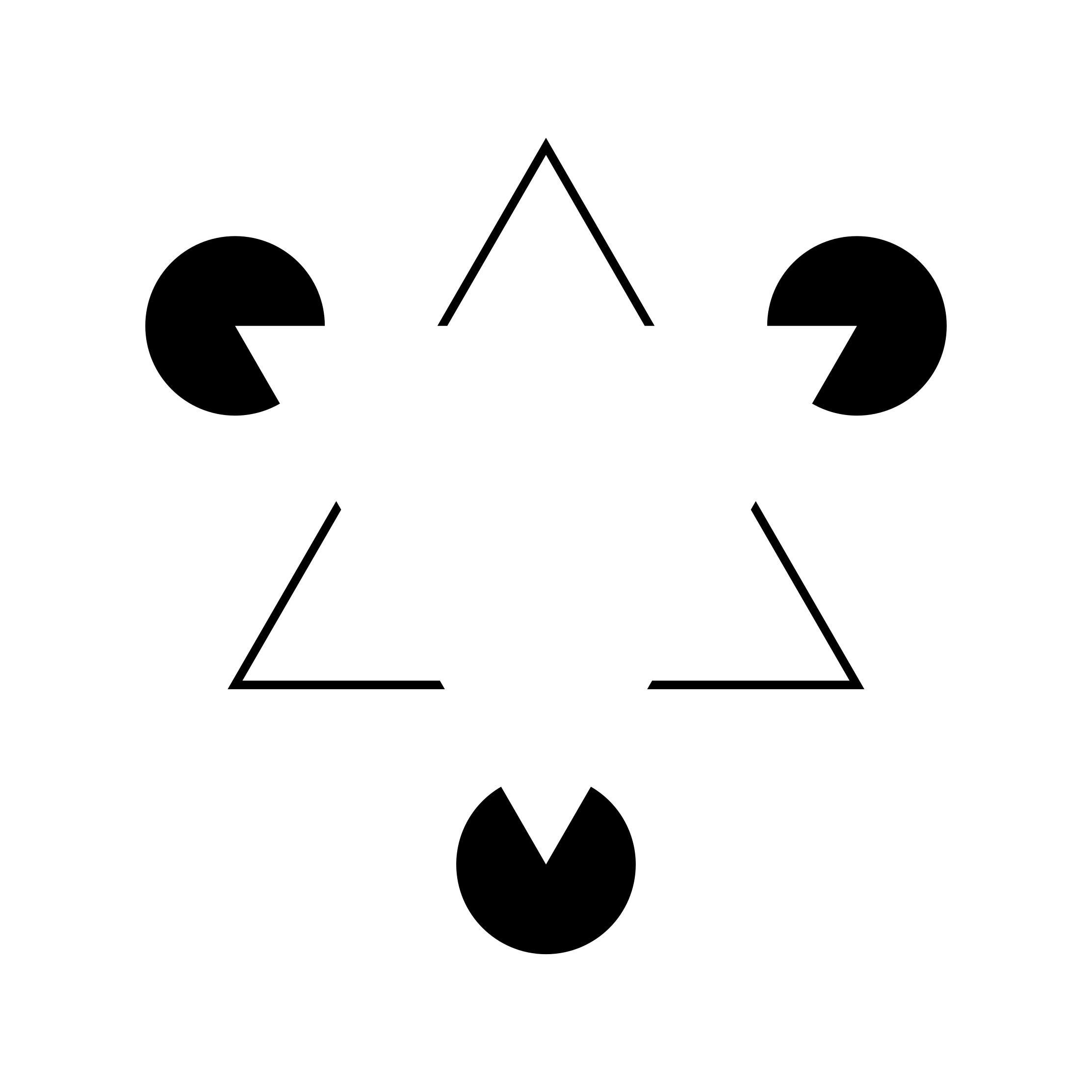
Photographs use the same instinct all the time. When a shadow swallows the edge of a building, the eye finishes the edge anyway, which means a frame can leave a great deal out and still feel complete. A related habit, called continuation, is the way the eye keeps following a line once it has started, a road, a railing or the curve of a shoulder, carrying the viewer from one part of the picture to the next even when the line is broken along the way.
A way of seeing, not a checklist
None of this is a checklist, and a photograph does not get better by ticking off principles. They describe how seeing works, not how a picture should look. Where they are most useful is in explaining a frame that feels wrong without any obvious reason. Two subjects in the same tone merging into one blob, a group split in half by the edge of the frame, or a strong line that leads the eye straight out of the picture are all Gestalt problems, and naming them makes them much easier to fix. Plenty of great photographs break these habits on purpose too, and they work because the tension is deliberate.
A viewer’s mind will organize our photographs whether we plan for it or not, the same way it has been finding a hunter in the winter sky for as long as anyone has looked up. The lines will always get drawn. Our job is simply to decide where the stars go.