A photograph cannot move, but the eye moving through it can keep a beat. Rhythm is how we set the tempo.
Walk past a long fence and the posts go by one after another, post, gap, post, gap, until the steady beat of it almost starts to feel like music. A photograph can do the same thing while standing perfectly still. When shapes repeat across a frame, the eye stops wandering and starts stepping from one to the next, and that steady movement is what photographers mean by rhythm. It is one of the quieter ideas in composition, and one of the most useful in black and white.
What rhythm actually is
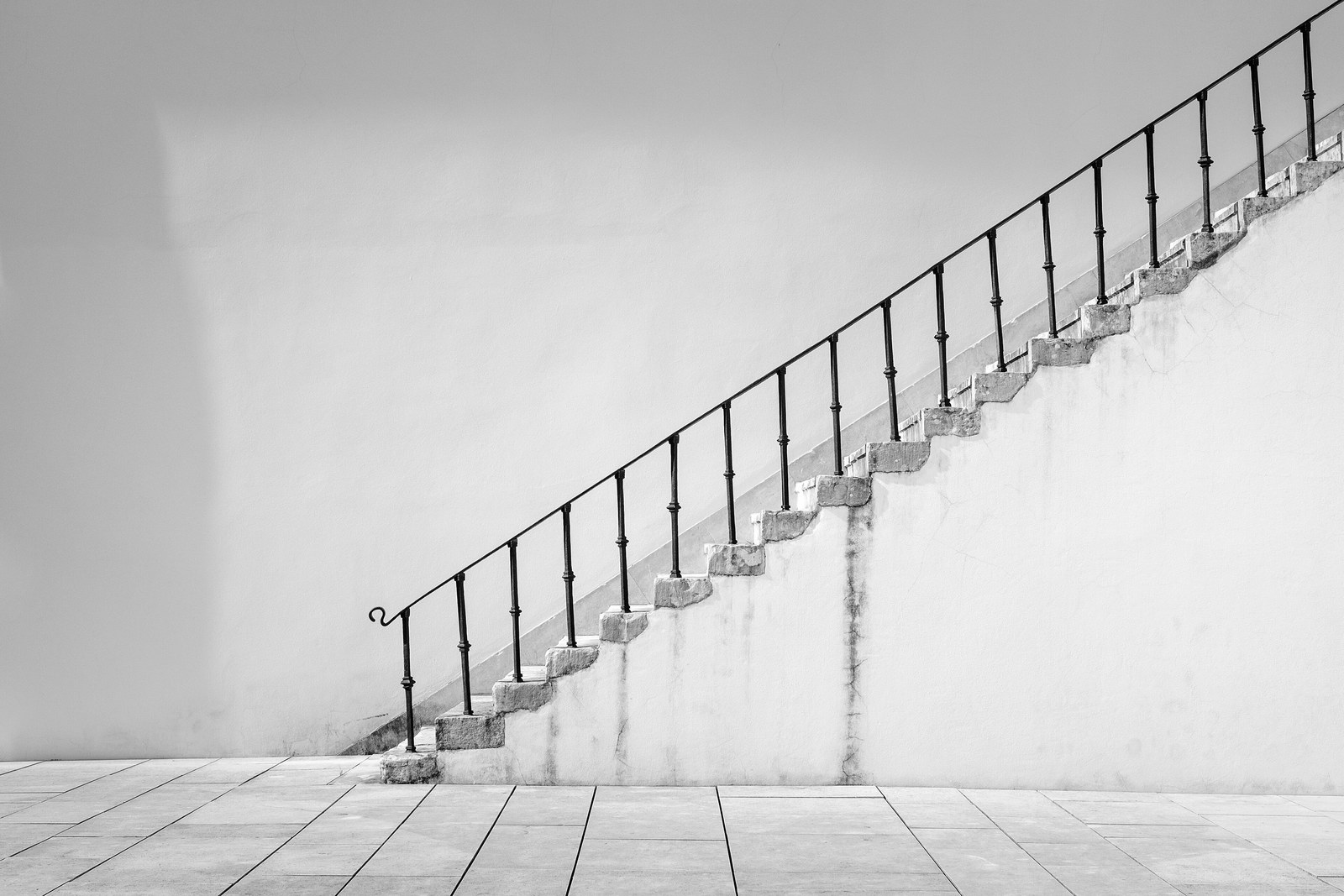
Rhythm is simply repetition with space in between. A row of windows, the steps of a staircase, the posts of a railing, a line of people waiting for a bus, each one is a shape that comes back again and again, with a gap before it returns. The shapes are the beats and the gaps are the pauses, and the pauses matter just as much. Squeeze everything together and the rhythm turns into a blur. Spread it too far apart and it falls away into separate objects.
It is worth separating rhythm from pattern, because the two get used as if they were the same. A pattern repeats evenly in every direction and can sit still, like tiles on a floor. Rhythm has a direction. It leads the eye somewhere, along the stairs, down the street or across the frame, which is why it feels alive in a way a flat pattern often does not.
Why the eye enjoys it
Our eyes are always trying to make sense of what they see, and repetition makes that easy. Once the eye has found the first two or three repeated shapes, it knows what comes next and moves along the line on its own, without effort. There is a small satisfaction in that, the same feeling of a song settling into its groove. Rhythm also brings order to a scene that might otherwise feel busy, giving the eye a path to follow instead of a crowd of details competing for attention.
Then there is the other side of it. Because the eye expects the beat to continue, anything that breaks it jumps out immediately. One open window in a row of closed ones, one person on an empty staircase, one post leaning where the rest stand straight. The rhythm sets up the expectation, and the break is where the eye stops.
Three kinds of rhythm to look for
The simplest is a regular rhythm, the same shape at the same spacing, like balusters on a railing or columns along a building. It feels calm, orderly and a little formal. An alternating rhythm takes turns between two things, light then dark, arch then pillar, window then wall, and it has a livelier swing to it. A flowing rhythm changes as it goes, shapes that grow smaller as they recede into the distance or curve around a bend, like a row of houses disappearing down a street or waves rolling toward a beach. That kind pulls the eye deepest into the picture.
Light makes rhythm too
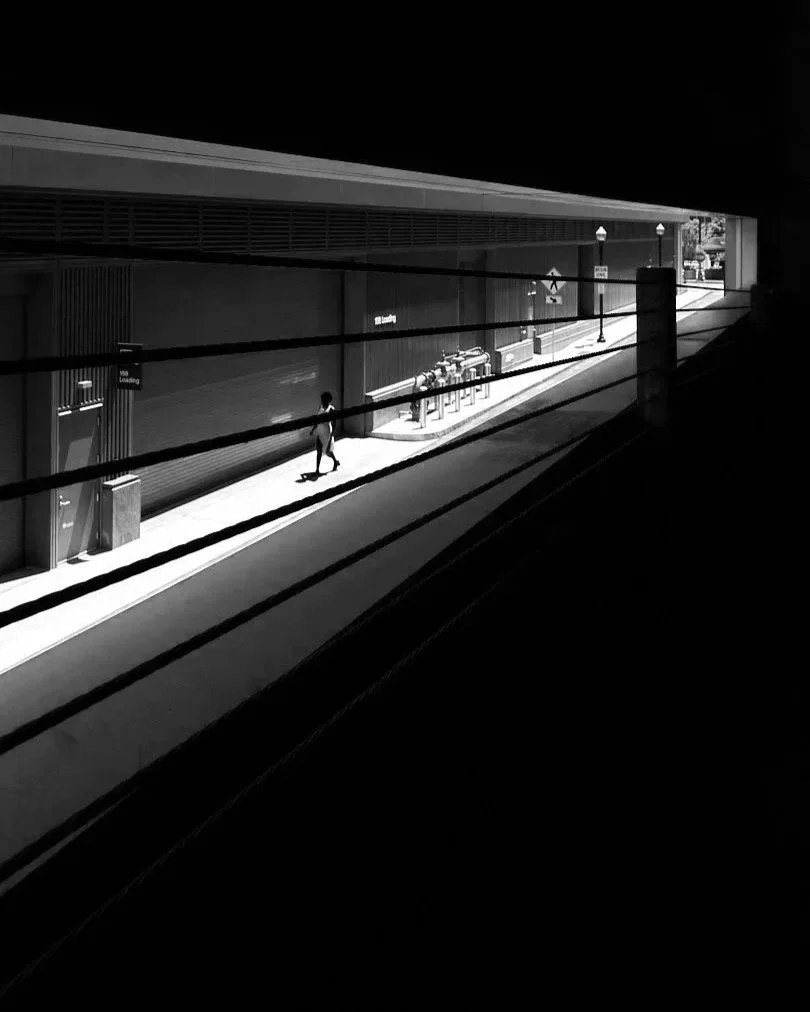
Some of the strongest rhythms in black and white are not objects at all but shadows. Low sun coming through a railing, a fence, window blinds or the slats of a bench throws stripes of dark and light across the ground, and suddenly a plain pavement has a beat. Without color to compete with them, those bands of tone can carry a whole photograph, which is why it helps to think of a frame as shapes of light and dark before thinking of it as things.
How to find it and use it
Rhythm is everywhere once we start looking, in architecture, stairs, parking lots, market stalls, rows of trees and the ripples on water. The angle we choose decides how it reads. Standing square on to a row of windows gives a flat, even beat. Moving to one side and looking along the row makes the shapes shrink into the distance, turning a regular rhythm into a flowing one. A longer lens pulls repeated shapes closer together so they stack up, and looking straight down from above can flatten a scene into a clean, graphic rhythm.
The edges of the frame matter as well. Letting the repetition run off the sides suggests it carries on forever, while catching where it starts and stops makes it feel contained. And once the rhythm is in place, it is genuinely worth waiting a little. The person walking into the one empty space, the bird landing on the one clear post, is very often what turns a pleasing arrangement into an actual photograph.
When rhythm turns into wallpaper
Repetition on its own is pleasant, but pleasant is not always enough. A frame full of perfectly even shapes with nothing happening to them can look more like wallpaper than a photograph, easy to admire and just as easy to forget. The rhythm is usually the setting rather than the story, and the pictures people remember tend to give that setting something to happen to, a figure, a gap, a single shape out of step with the rest.
So rhythm is less a decoration than a tempo, the pace at which a viewer walks through our photograph, step by step, from one repeated shape to the next. The repetition gets them moving. The break is where they stay.