Software can now do almost everything a filter used to. These two change the light before it reaches the sensor, and that is the part no slider can put back.
For most of photography’s history, black and white photographers carried a small pouch of colored filters, a yellow to darken a sky a little and a red to darken it a lot. Most of that work has moved into software now, and for good reason, since the color editor can do the same job after the fact and with far more control. It is tempting to conclude that filters are finished. Two of them are not, because what they do happens to the light itself, before the shutter opens, and no amount of editing can recreate it.
What software can and cannot put back
An edit can only work with what the sensor recorded. It can darken a sky, lift a shadow or add grain, but it cannot invent light that was never captured, and it cannot record time that did not pass. The two filters worth carrying do exactly those things. One changes how light spreads around the brightest parts of the frame, and the other changes how long the frame stays open. Both happen once, at the moment of exposure, which is also why they deserve some thought.
The black mist filter and the glow digital lost
Modern lenses and sensors are remarkably clean. Highlights end abruptly, fine detail stays crisp right to the edge, and there is very little of the soft spill of light around bright areas that older lenses and film tended to give us. In color that cleanliness often reads as precision. In black and white, where the way a highlight fades into the tones around it carries so much of the mood, it can start to read as clinical.
A black mist filter puts some of that back. Tiffen, which makes the best known version, says its regular Pro-Mist softens fine detail, lowers contrast and adds a soft flare around highlights, and that the Black Pro-Mist does the same while not lowering contrast as much, keeping blacks black. That one difference is the whole reason the black version suits monochrome. A frame can pick up a gentle glow around a window, a streetlight or a bright sky without its shadows turning to milky gray, which is usually the first thing that ruins a black and white image made through diffusion.
The strength matters more than the filter itself. The grades run from very light, labeled with fractions like 1/8 and 1/4, up to heavy densities where the glow becomes the subject. For most black and white work the gentle end is where it genuinely earns its place, taking the edge off harsh highlights and softening skin a little without anyone noticing a filter was used at all. Night is where it shows most. Every point of light picks up a small halo, and a street that looked hard and busy starts to feel quieter.
The ND filter and the photograph that takes a minute
A neutral density filter does something simpler. It cuts the amount of light reaching the sensor without changing its color, which lets the shutter stay open far longer than the light would otherwise allow. The strength is usually given in stops, or as an optical density where every 0.3 equals one stop, so an ND 3.0 is a ten stop filter. Each stop doubles the exposure time, and ten of them multiply it by 1,024, which turns an exposure of 1/30 of a second on a bright beach into roughly 34 seconds.
Why long exposure belongs to black and white
Time does something to a scene that suits monochrome remarkably well. Moving water loses its detail and becomes a smooth field of gray. Clouds turn into soft streaks. People walking through a square simply disappear if they keep moving. What is left is the part of the scene that holds still, the pier, the rocks, the building, sitting against broad areas of even tone, which is almost exactly the kind of picture black and white does best, a few strong shapes and very little clutter around them. It is not only a landscape technique either, as long exposure on the street has shown.
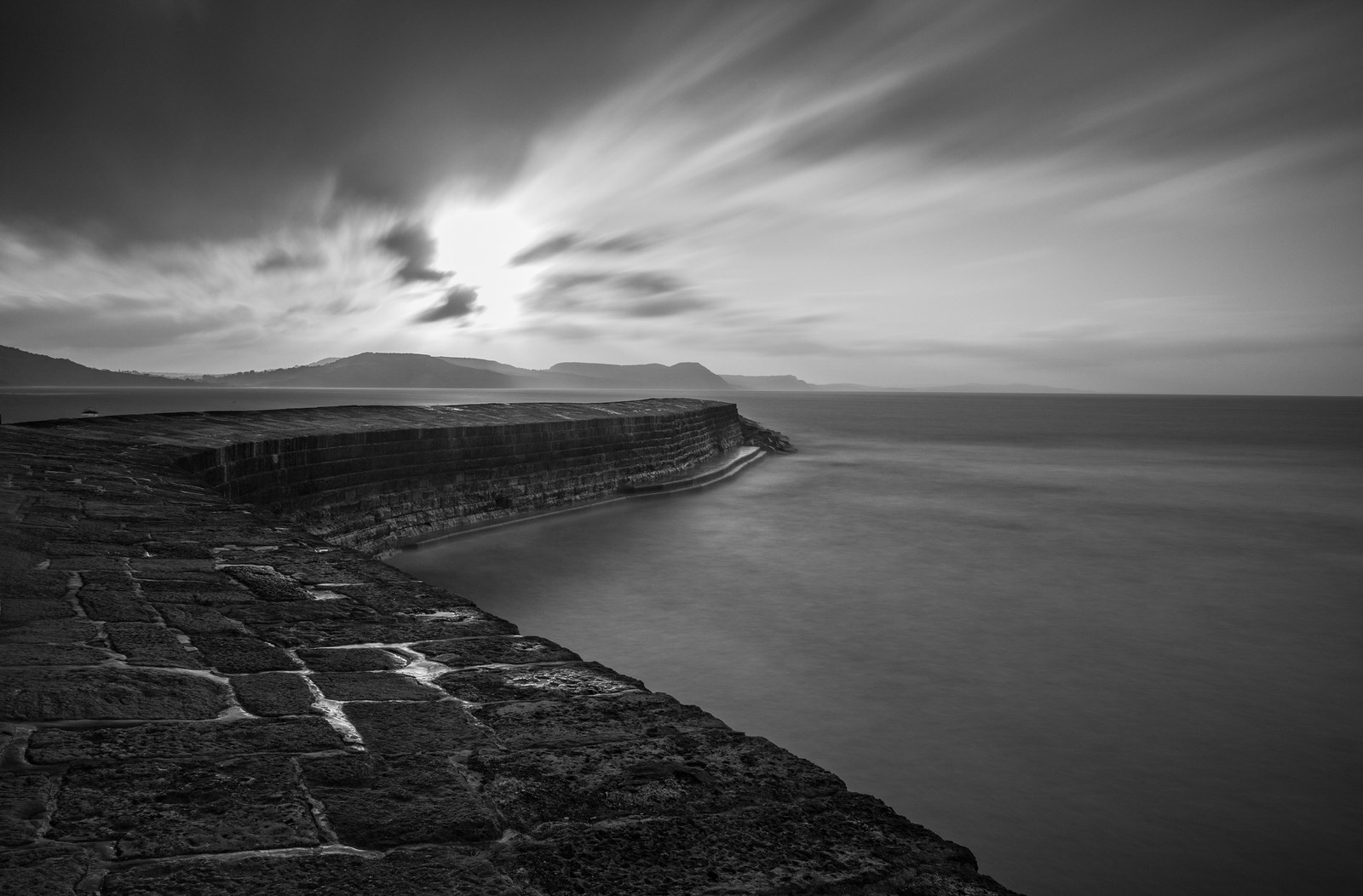
There is a practical bonus as well. Stronger and cheaper ND filters often leave a color cast, and on digital sensors much of it comes from infrared light leaking through during long exposures, usually as a warm or magenta tint that white balance cannot quite correct. In black and white that cast disappears the moment the image is converted. What does not disappear is the other effect of the same infrared leak, a loss of contrast that leaves the image looking flat and muddy, so a filter with proper infrared protection is still worth paying for even when color never enters the picture.
What they ask of us
Neither filter can be undone. A black mist filter softens every frame it is on, including the ones that would have been better sharp, and an ND filter commits us to a tripod, some patience and a scene willing to hold still. The two can be stacked, and a light mist filter in front of a long exposure gives water and light a softness that suits them, but every extra layer of glass is another chance for flare, reflections or a dark corner creeping in, especially on a wide lens.
That commitment is actually the point. Almost everything we do in black and white can now be adjusted endlessly after the fact, and there is real freedom in that, but these two filters ask us to decide what the light should do while we are still standing in front of it. It is a slower way of working. It also tends to produce photographs that feel made rather than fixed.