
A corridor with nobody in it is not an empty photograph. It is a photograph of an absence, and there is a reason that works.
What liminal photography actually is
The root is the Latin līmen, a threshold. Not threshold as metaphor but the literal thing, the sill of a doorway, the piece of stone or timber you step over. A threshold is the one part of a building you are neither inside nor outside of. You are on it for about half a second and then you are somewhere.
English picked the word up around 1875, and not from anthropology. It came through psychology, where the limen was the threshold of sensation, the intensity a stimulus has to reach before you notice it at all. Which is why we also have the word subliminal, from the same root, meaning below that line. Worth holding onto, because it describes how these photographs work on people. The unease arrives before the noticing does.
The sense we mean arrived in 1909, when Arnold van Gennep divided rites of passage into three stages, and named the middle one liminal, from the Latin for threshold. It’s the part where you’ve left what you were and haven’t yet become the next thing. Victor Turner later described that state as being betwixt and between.
Apply that to architecture and you get the subject. A liminal space is one built to be passed through rather than arrived at. Corridors. Stairwells. Waiting rooms. Car parks. Station concourses. Nobody’s destination is the corridor. It exists to connect two places that matter, and it was never designed to be looked at.
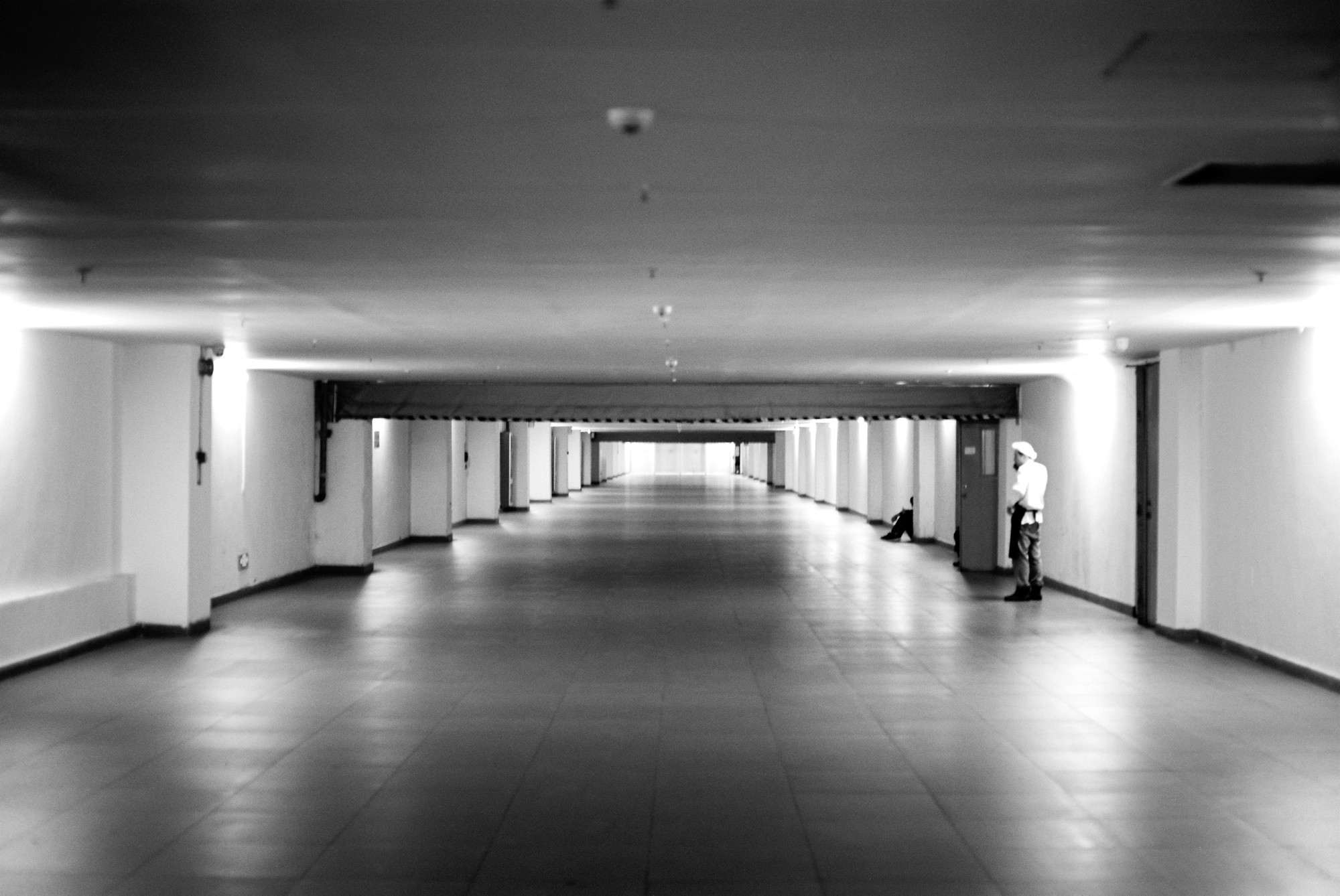
The internet version arrived in May 2019, when somebody on 4chan’s paranormal board asked for disquieting images that just feel off. One reply was a photograph of a dim carpeted room under fluorescent tubes. Another user wrote a caption about noclipping out of reality into an endless maze of empty offices, and the Backrooms existed. The photograph turned out to be an ordinary picture of a building in Oshkosh, Wisconsin taken before a renovation, and it took until 2024 for anyone to establish that.
Then 2020 handed everybody the real thing. Cities built for crowds, running normally, with the crowds removed. A niche aesthetic became something everyone had personally stood in.
Empty is not the same as liminal
This is the distinction that decides whether your photograph works, so it’s worth getting straight before anything else.
An empty moor is just a moor. Nobody expects people there, so their absence means nothing. A liminal photograph is of a space built for people and photographed without them. The subject isn’t the room. The subject is the missing traffic the architecture keeps insisting on. Handrails with no hands. Two hundred seats in rows. A door wedged open for nobody.
There’s a word for the feeling, invented rather than inherited. Kenopsia, the particular melancholy of a place that is usually full and currently isn’t. A school at night. An office on a Sunday. It isn’t solitude, because solitude needs no witnesses and this badly wants some.
Why the absence registers
Ask people why these pictures unsettle them and most can’t say. The answers are more interesting than the aesthetic.
Your brain made a prediction and the picture broke it. We don’t see so much as anticipate, constantly and below the level of thought. A corridor predicts footsteps. A row of seats predicts occupants. When the prediction fails and nothing explains why, the error doesn’t resolve, and an unresolved error with no identifiable threat arrives as unease. You feel it well before you could name it.
The building is talking to somebody who isn’t there. These spaces are full of instructions. Arrows on the floor, numbered doors, queue barriers, exit signs, a handrail at exactly the height of a hand. All of it addresses a person. Photograph it with the person removed and you have a message with no recipient, which is a genuinely strange object and much more specific than ordinary emptiness.
It feels like memory without being one. Liminal spaces are generic by design, because a hotel corridor is meant to work for anyone. So they activate recognition without matching anything in particular. You are certain you have been there and you have not. That mismatch is the uncanny in its strict sense, familiar and wrong at once.
A lot of them are childhood rooms. School corridors, municipal pools, waiting rooms, motel landings. These are places many of us last paid real attention to when we were small, had no say in anything and found rooms larger than they are. That accounts for the particular flavor of the dread, which is closer to being left behind than to being threatened.
And the viewer supplies the rest. An image that withholds invites completion, and what people reliably complete an empty room with is a presence. Nothing in the frame threatens anybody. The threat is manufactured by the person looking, which is the power of suggestion doing what it always does, pointed somewhere colder than usual.
The internet version is mostly a color trick
Which brings us to a problem, because the aesthetic as it circulates runs on a palette. Fluorescent green. Sodium orange. The mustard of commercial carpet from about 1994. Pool tile blue.
Those aren’t colors so much as triggers, and the unease they produce is nostalgia running slightly wrong. Take a typical liminal image into monochrome and a lot of them collapse into a snapshot of a corridor. Which is a useful test well beyond this subject. If a photograph stops working the moment the color goes, the color was the idea.
The thing itself was never dependent on that. Eugène Atget photographed Paris from the 1890s onward, deliberately at dawn so the streets would be empty, and his city reads like a stage set after the cast went home. The New Topographics exhibition in 1975 gathered photographers pointing deadpan cameras at tract housing and parking lots with nobody in them. Hiroshi Sugimoto photographed cinemas with the shutter open for an entire film, so the screen burns to white and the auditorium sits lit by a movie nobody is watching. None of them called it liminal. All of them were working in black and white.
How to make one
Strip out the palette and four things carry it, all of them more durable than a color reference that only lands for people of a certain age.
Light with no visible source and no business being on. Overhead fluorescent at four in the afternoon. A lit stairwell in a closed building. Daylight is honest and mostly unhelpful here, because light that makes sense reassures people.
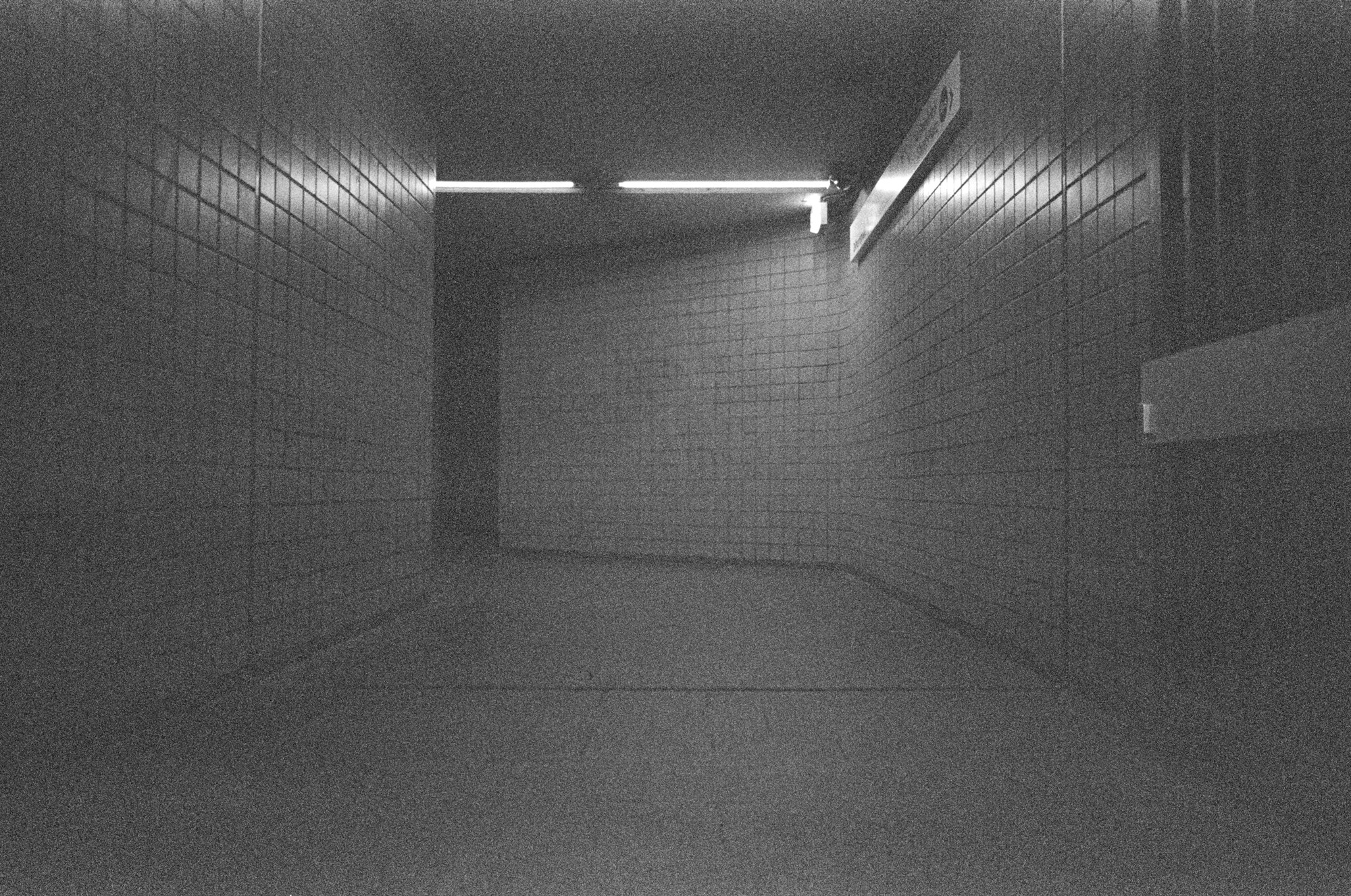
Repetition that offers no exit. Identical doors, columns, seats, receding. It tells the eye there’s no reason to stop at any one of them, which is how a corridor actually feels and the opposite of what composition advice usually tells you.
Dead center symmetry. One point perspective, square to the wall, straight down the middle. It reads as inhuman because nobody stands like that, and it turns the space into a diagram of itself. You’ll feel like you’re doing it wrong. You have been trained out of symmetry for reasons that don’t apply here.
Evidence without presence. The chair pushed back. The worn patch where the queue stands. A cup. These are the hands of the missing people and they’re what separates a space that is empty from one that has been vacated. Without them you have minimalism so quiet it stops saying anything.
Where to go this weekend
You don’t need an abandoned mall. The variable is the hour, not the location.
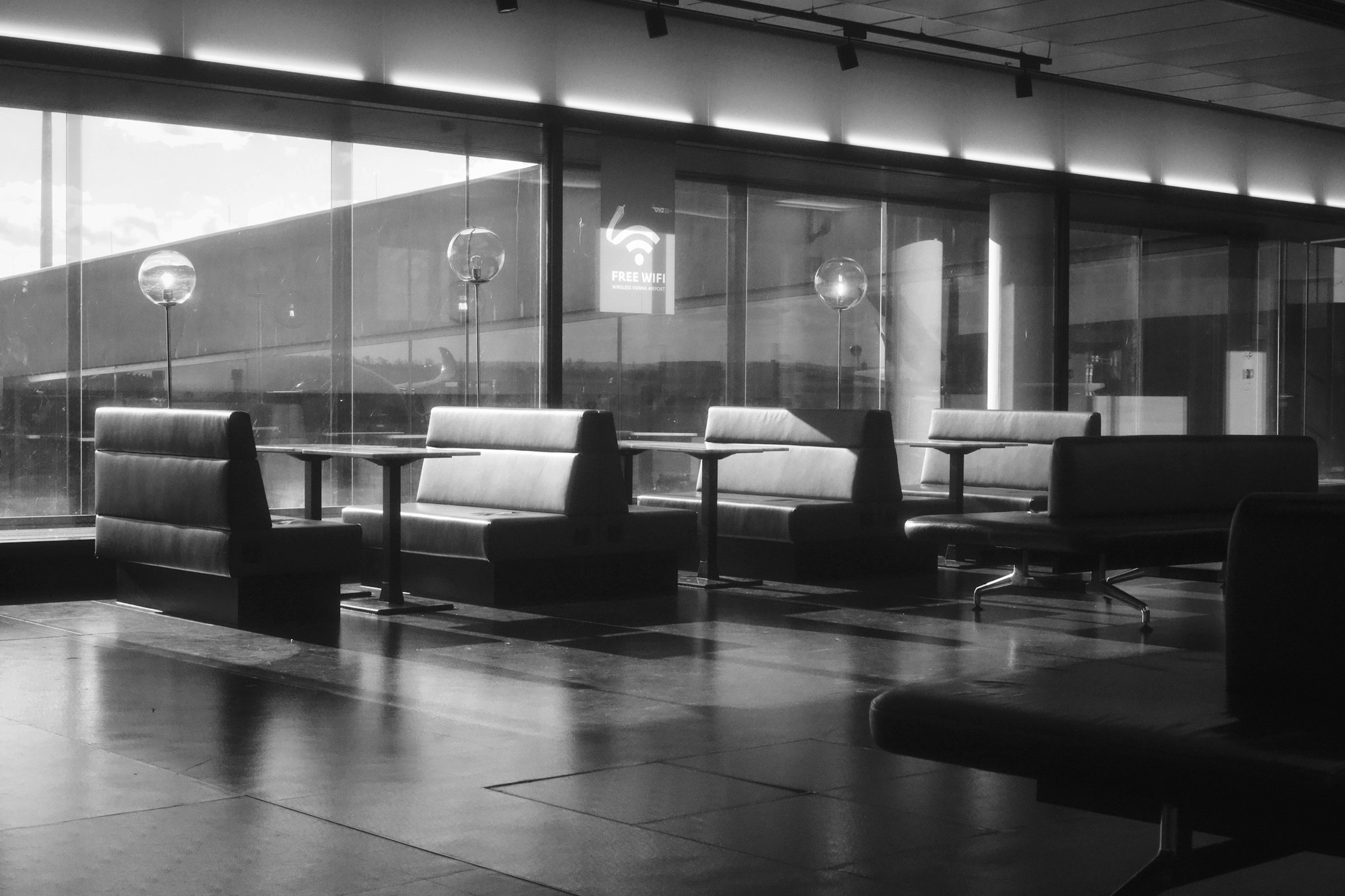
Photograph a place built for crowds at the hour it has none. A business district on a Sunday morning. A shopping street at six. A station between trains. A multi storey car park on a weeknight. Avoid night, because night has its own meaning and emptiness is expected then. You want the wrong hour, when a space is lit and open and operating and nobody has turned up.
Photograph the transit space rather than the destination. The corridor, not the room it leads to. The escalator, not the shop. The waiting area, not the thing being waited for. Then resist improving it. Flat, boring light is correct. A dramatic sky will rescue your picture straight out of the category you were aiming at.
The internet thinks these places are unsettling because of the carpet. They’re unsettling because a building full of instructions is carrying nobody, and that reads as wrongness in any tonal range you like.
Photographs by Claudio Schwarz, Lei Hwang, Markus Spiske and Dennis Schmidt on Unsplash, converted to black and white.