Breaking the rules sounds brave. Bending one is harder, and it works far more often, because the rules got to be rules by being right.
There’s a line that gets repeated so often in photography that most of us have stopped hearing it. Forget the rules. Rules are for beginners. Shoot what you feel.
It’s a great line. It sounds fearless. It’s also usually the least interesting thing anyone in the room can say, partly because nothing is more conventional than announcing that you ignore conventions.
And there’s a bigger problem with it. The rules work. That’s how they became rules. They aren’t opinions somebody handed down to spoil our fun, they’re notes about how people actually look at pictures, and they’ve been tested on more viewers than any of us will ever reach. Throwing them away doesn’t make us free. It just means we’re ignoring research that somebody already did on our behalf.
The move that actually gets us somewhere isn’t breaking. It’s bending.
Every rule has a letter and a principle
This is the whole idea, so it’s worth getting straight before anything else.
The letter of a rule is the instruction. The principle is the reason the instruction exists.
Take the rule of thirds. The letter says put the subject a third of the way across the frame. The principle is simply this: don’t put it in the middle.
Or take symmetry. The letter says line everything up dead straight. The principle is that we’re giving the frame an order the eye can trust.
Breaking a rule means throwing out the principle. Bending it means keeping the principle and playing with the letter, usually by pushing it further in the direction it was already pointing. Most of these rules came over from painting in the first place, and they arrived as guidelines rather than commandments. Once we can see the difference between the two, we can’t stop seeing it.
If a third is good, what about a fifth?
Let’s take the rule of thirds at its word.
The instruction says one third. But the principle is only ever not the center. And if that’s really the principle, then a third isn’t the answer. It’s one answer, and a fairly cautious one at that.
So why stop there? Push the subject out to a fifth of the frame. Then push it further, right out toward the edge, until it starts to feel like slightly too much.
We haven’t broken a thing. We’ve taken the rule more seriously than it took itself. Off center has become emphatically off center, and the frame picks up a friction that a tidy third never gives us. The eye has further to travel. The empty space gets big enough that it stops being background and starts doing work of its own. We’ve written about this before as the rule of fifths, and that’s all it is, the same principle taken one step past where it usually stops.
There’s a neat test hiding in here too. Slide the subject the other way, back toward the middle, and most of the time the photograph dies on the spot. That direction is the break, not the bend, and it’s a much bigger ask. It can be wonderful, but only when the center is genuinely the point, and that’s a different post and a different kind of decision.
We don’t have to destroy symmetry, we can just interrupt it
Same move, different rule, and this one’s even clearer.
We find a symmetrical scene. A mirrored lobby, a reflection in still water, a corridor running straight away from us. The usual advice offers exactly two choices. Shoot it perfectly square on, or abandon symmetry and go looking for something asymmetrical instead. It’s that switch again. On or off.
There’s a third option and it beats both of them. Keep the symmetry, and put one thing across it.
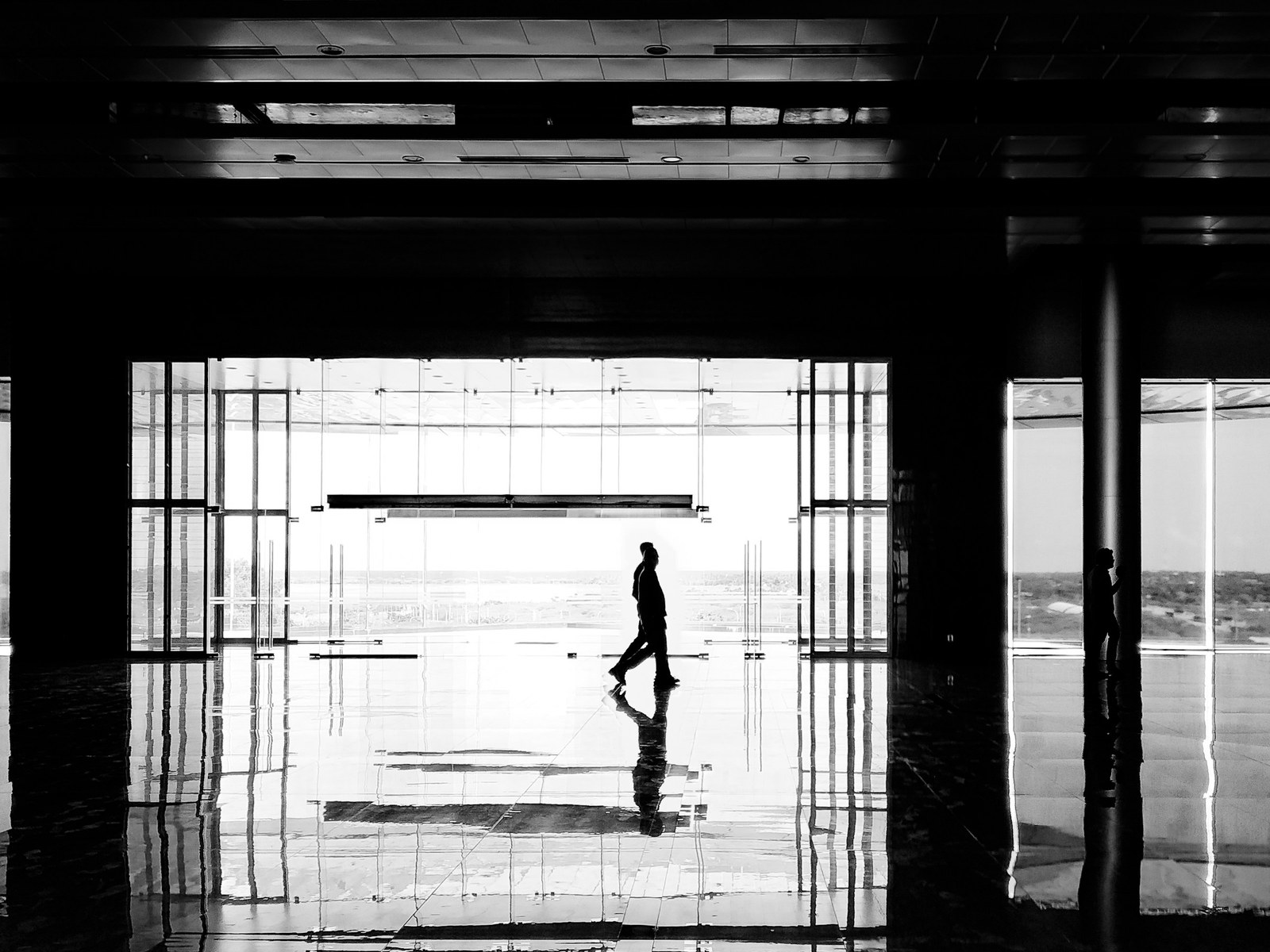
A figure walking through a mirrored hall. A bird sitting on one side of a reflection and not the other. A shadow that cuts across one half and leaves the other alone.
The architecture is still doing its job. The eye gets the order it was promised, which is what makes a symmetrical frame feel calm and deliberate and built. Then it finds the one element that isn’t on the grid, and that’s where it settles, because that’s the only thing in the picture with anything to say.
Symmetry gives us the calm. The intruder gives us the photograph. We only get both if we keep the rule, which is why the decision about the mirror matters more than the mirror.
The rules have earned more respect than they usually get
Painting spent a few centuries watching how people look at things before anyone built a camera, and photography inherited the notes. They aren’t perfect and plenty of them are oversimplified, but they’re the closest thing we have to a record of what the eye does when it’s left alone with a picture.
So when we say rules are made to be broken, what we’re often really saying is that we’d rather not find out why this one works.
Which is allowed. But the photographers whose work we keep going back to didn’t skip that part. They learned the rules well enough that the reasons underneath became obvious, and then they started pushing on the reasons instead of on the rules.
Breaking is real, it’s just rare
To be fair about it, sometimes we genuinely do throw out the principle and it works beautifully.
Dead center, perfectly symmetrical, nothing anywhere for the eye to do, because stillness is the subject. A face that goes all the way to silhouette because the shape turns out to be worth more than the features were. Those are real breaks and they can be the best frame in the set.
But they’re loud, and they only land if the viewer can feel the rule being broken. If nobody expects a subject anywhere except the middle, a centered frame doesn’t read as bold, it reads as the default. A break borrows every bit of its force from the rule it’s breaking, which is why a portfolio that breaks everything ends up feeling strangely flat. After fifteen of them nobody is surprised any more, they’re just looking at our habits.
And one more thing, said plainly. We can’t break a rule we never learned to follow. A crooked horizon nobody noticed isn’t rebellion. It’s a crooked horizon.
Four bends to try this week
Pick a rule we follow without thinking about it. Work out what it’s actually for. Then head further in that direction rather than the opposite one.
Off center. Take it from a third to a fifth, then keep going until it’s almost uncomfortable, and find out where it stops working. That edge is useful information.
Negative space. Give it more than seems sensible. Then give it more again.
Symmetry. Find a symmetrical scene and simply wait for one person to walk into it. Don’t recompose, don’t go hunting for a better angle. Just wait.
Tone. If we’re working dark, don’t darken everything equally. Make the lit area smaller than feels safe and let the rest go.
None of that is rebellion, and none of it is obedience either. It’s reading the instruction, working out what it was really asking for, and then asking for more of it than the instruction itself had the nerve to.