Twelve plain questions, answered for the USA, the UK and the EU.
Street is the biggest thing this community makes, and almost all of it contains people who were never asked. Most of us only find out what we were allowed to do on the day somebody objects.
So here it is in plain language. One warning before we start, and it matters. This is a general guide and not legal advice. The three systems below differ, they change, and the country where you publish can matter as much as the country where you stood. Treat this as the map, then go and read the road signs where you live.
Do I need permission to take someone’s photo?
In a public place, generally no, in all three.
In the USA there’s no general requirement to get consent before photographing a person in public. In the UK no permit is needed to photograph in a public place, and the Metropolitan Police say so in their own published advice. In the EU, simply taking the picture for yourself usually falls under what the GDPR calls the household exemption.
The thing almost everyone gets backwards is that the pinch point isn’t the shutter. It’s publication. Hold that thought, because most of the real answers below depend on it.
One exception worth knowing anywhere. Repeatedly following or targeting one person can become harassment, and at that point how lawful the first frame was stops mattering.
What if the person isn’t recognisable?
This changes the answer more than people expect, particularly in the EU.
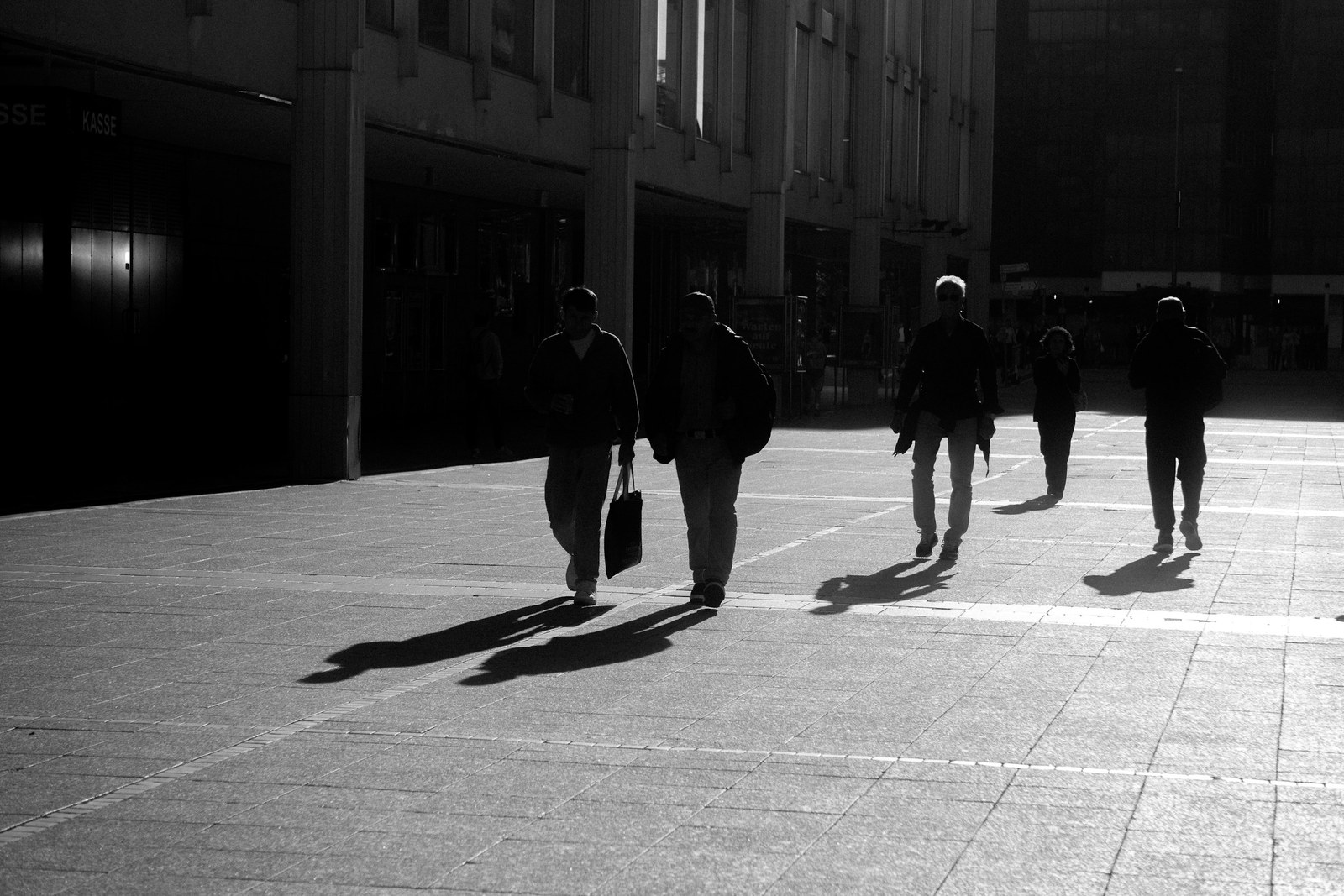
The GDPR only applies to personal data, which means a person who can be identified. A silhouette, a figure seen from behind, somebody far enough away to be a shape, and the whole data protection question tends to fall away because there’s no identifiable person in the frame.
Be honest about what identifiable means though. A face isn’t the only way somebody gets recognised. A distinctive coat, a wheelchair, a tattoo, a workplace uniform or simply a location where only one person stands can do it just as well.
Can I photograph children?
Legally, in a public place, the rules are mostly the same as for adults. There’s no general offence in the USA or the UK in simply photographing a child who’s out in the world.
Publication is where it separates. Courts have been noticeably more willing to find that a child had a reasonable expectation of privacy, even somewhere public, and specific venues such as schools, playgrounds and swimming pools usually have their own rules that have nothing to do with national law.
Then there’s the practical reality, which is that you’re far more likely to be challenged, and that the conversation will be tense no matter how polite you are. Plenty of photographers simply decide the picture isn’t worth it. That’s a legitimate position rather than a timid one.
Does it matter if I use a phone instead of a camera?
Not legally, anywhere. The law is interested in what you do and what you then do with it, never in the device.
Socially it makes an enormous difference, which is why the myth persists. A phone attracts no attention and a large camera with a lens on the front reads as intent. That’s a difference in how people react to you, not in what you’re entitled to do.
What if someone is on private property, like inside a cafe window?
The question that decides these next three is not where your subject is. It’s where you are standing.
Standing on a public pavement photographing through a cafe window is generally lawful in the USA and the UK, because you’re entitled to be where you are and to photograph what’s visible from there.
What limits it is how private the space really is. A cafe is a commercial room with a glass front and almost no expectation of privacy. A bedroom window is the opposite, and photographing into one from the street is a different matter entirely, however public your pavement is. The more private the space, the more the camera’s reach becomes the problem rather than your position.
Can I shoot inside shopping malls, subways, or museums?
Only if the owner allows it, and they decide, not you.
Shopping centres, station concourses and museums are private or controlled property even when they feel like public space. The owner can set any photography rule they like, can ask you to stop, and can ask you to leave. Many transit systems permit personal photography but ban tripods, flash or anything that looks professional. Museums often restrict it because of copyright in the works or the terms of a loan rather than out of fussiness.
Being asked to stop isn’t an accusation that you broke a law. Refusing to leave after being asked is where you’d actually be in the wrong.
Are there restricted public areas?
Yes, and some of them look like ordinary streets.
Military sites, secure areas of airports and the inside of courtrooms are restricted in most countries. In the UK, bylaws limit commercial photography in places including Trafalgar Square, Parliament Square and the Royal Parks. A great many city squares and precincts that feel entirely public turn out to be privately owned, which puts them in the previous answer rather than this one.
When do I need a model release?
The short version is that you need one when the use is commercial, meaning the photograph is helping to sell or endorse something. Advertising, packaging, a company website, most stock libraries.
You generally don’t need one for editorial and artistic use in the USA and the UK, which covers journalism, books, exhibitions and prints.
In the EU a release does more work, because it’s the cleanest evidence of consent, and consent carries more weight there. Germany is the clearest example. Its image rights law requires consent to publish or publicly display a person’s picture, with carve outs for images of contemporary history, people who appear incidentally beside a place, and public assemblies, and advertising is never carved out.
Can I post it on Instagram, put it in a book, or sell fine art prints?
This is where the three systems separate most, and where the word commercial causes the most confusion.
Selling a print is commercial in the everyday sense of money changing hands, but in the USA and the UK it’s generally still treated as expressive or artistic use rather than the advertising kind, so posting, publishing and selling prints are broadly fine. The UK adds a caution, which is that publication can still be challenged if the picture exposes something genuinely private about the person.
The EU is the one to be careful with. Publishing publicly or selling can take you outside the household exemption and make you a data controller, which means you need a lawful basis for using that person’s image. There’s an artistic and journalistic exemption, but the GDPR hands the detail of it to each member state, so it genuinely differs between France, Germany and Ireland. Anyone selling or exhibiting in the EU should read their own country’s version rather than a summary like this one.
Someone has asked me to take it down. Do I have to?
In the EU, quite possibly. An identifiable person may have a right to erasure, and if you were relying on their consent then withdrawing it ends your basis for using the picture.
In the USA and the UK, if the publication was lawful there’s usually no obligation.
Almost everyone takes it down anyway, and that instinct is sound. One frame is rarely worth the argument, and a photographer who removes a picture when genuinely asked keeps something more useful than that picture.
Can I photograph police officers?
Yes, and this one is clearer than most people assume.
The Metropolitan Police state in their own advice that the public and the media don’t need a permit to film or photograph in public places, and that officers have no power to stop them filming or photographing incidents or police personnel. In the USA, recording police performing their duties in public is broadly treated as protected.
The practical limits are the obvious ones. Don’t obstruct, don’t get so close you’re in the way, and understand that being within your rights and being left alone are not the same thing.
Can a police officer or security guard force me to delete my photos?
No, and this is the single most useful thing in this article.
In the UK, an officer searching you under the Terrorism Act may look at images on your camera or phone, but has no power to delete digital images or destroy film. Once an image exists, there’s no power to delete or seize it without a court order. In the USA the position is similar, with deletion or seizure generally requiring a warrant.
A security guard has no such power at all, in any of these places. What a guard can do is ask you to stop and ask you to leave, and if you’re on their property you should go.
Knowing this is not the same as arguing it on a pavement. Stay calm, don’t hand the camera over, don’t delete anything under pressure, and don’t escalate. Being right has never once improved that conversation.
Now go and check your own country
Everything above is the shape of it, not the detail, and the detail is where you’d actually get caught out. France protects image rights far more strongly than this summary suggests. Some countries require consent even to take the picture. Within the EU the artistic exemption is written separately by each member state.
Half an hour will settle it. Look up your national police guidance for photographers, and if you’re in the EU, your country’s data protection authority, which will have published something plain about photography in public. If you sell, exhibit or publish, that half hour is the cheapest insurance you’ll ever buy.
And then remember that all of this is only the floor. Almost every photograph that has ever troubled anybody was perfectly legal. The law tells you what you can be made to answer for, never whether a particular person on a particular day belongs in your work, which is why the photographers worth reading keep asking themselves the harder question long after the legal one is settled.