
A camera is only a tool right up until it isn’t. Lot 205 is the one that made the Kuwait pictures.
The 49th Leitz Photographica Auction goes under the hammer at noon on November 28 at the Leitz Park in Wetzlar, with pre bidding already open and an online only sale called Leitz ON running alongside it until November 29. Most of what’s in it is the usual catalogue of prototypes, black paint rarities and lenses nobody outside the hobby has heard of. Three lots are something else, and they sit almost next to each other in the book.
Lot 205 is the camera from the burning oil fields
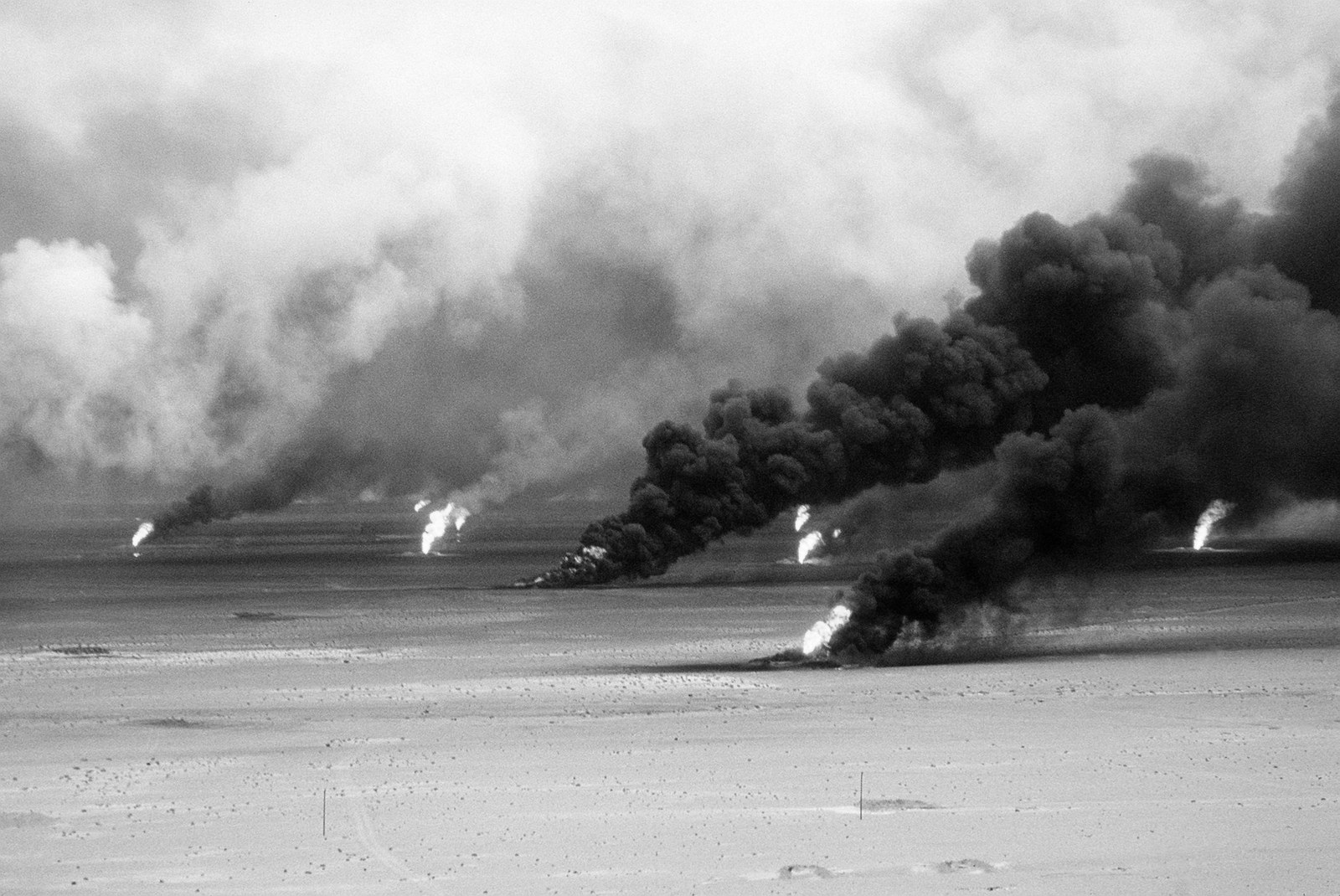
In 1991 Sebastião Salgado went to Kuwait to photograph the men putting out the oil well fires that retreating Iraqi forces had lit on their way out. He worked a Leica R6 with a Macro-Elmarit-R 2.8/60mm, and that camera, serial 1747647, built in 1988, is lot 205. Leitz has it starting at fourteen thousand euros with an estimate of twenty eight to thirty two thousand.
The pictures first ran in The New York Times Magazine that year and won him his second Leica Oskar Barnack Award the year after. They became one of the harder chapters of Workers, and in 2016 they got a book of their own as Kuwait: A Desert on Fire. When Salgado came home Leica stripped the camera down and repaired it, which tells us something about what the air in Kuwait was doing to equipment, and it went on show afterwards at the Leica Museum in Solms. It last came up at auction in 2005. Salgado died in May 2025 at eighty one, so this is the first time the camera has moved since the body of work closed for good.
What makes the lot unusual isn’t the camera. It’s that Leitz has bundled it with two original gelatin silver prints at 40 by 50 centimeters, signed by Salgado and carrying his blind stamp, plus artist’s proof number seven from an edition of thirty of the Workers book. So the buyer gets the instrument and the result in the same box, and there’s no honest way to say which half the money is actually for. That’s a more interesting question than it looks, because the prints are the photography and the camera is a relic, and the market has never been very good at telling us which one it values.
Two lots earlier, Otto Steinert’s own Leica
Lot 203 is a shark skin chrome Leica IIIc with Dr. Steinert Saarbrücken hand engraved on the back, delivered to him on October 19, 1948 according to the Leica archive, and still wearing an Elmar 3.5/5cm. Steinert was the doctor turned photographer who organized the first Subjektive Fotografie exhibition in Darmstadt in 1951 and then spent nearly twenty years at the Folkwang school in Essen teaching the generation that came after him. The lot also includes the catalogue of the Jacob Riis show he curated at Folkwang in 1971, and a note in his hand. It starts at two thousand euros.
Then lot 204 is one of his photographs. Schlammweiher 2, made in 1953, a vintage silver print still mounted on the exhibition board it was shown on, with his early Saarbrücken studio stamp on the reverse. Starting at three thousand two hundred euros, estimate four to five thousand.
The provenance on that print is the best thing in the sale
That Steinert print hung in a show called Otto Steinert and his students at the Museum of Modern Art in São Paulo in 1955, and the current owner bought it out of the archive of the Foto Cine Clube Bandeirante, the São Paulo camera club. A German print traveled to Brazil for an exhibition, stayed, sat in a club archive for seventy years and has now surfaced in Wetzlar with the board it was pinned to still attached.
That’s exactly the machinery Tate Modern is currently arguing for in its Pictorialism show, where a whole room is given over to camera clubs and salons as the network that moved photography between continents before anything existed to do it electronically. Here’s the physical proof of it, with a price on it. Prints went in the post, hung on somebody else’s wall on another continent, and stayed there. We tend to think of provenance as a line on a condition report. It’s really just a record of who cared enough to keep something.
The rest of it
Leitz is also putting up serial number 001 of the Summicron-M 66 f/2, the Classic Line revival of the lens Walter Mandler built at Ernst Leitz Canada for a classified US Navy job, and says the hammer price goes to the International Center of Photography. There’s a Noctilux run through the catalogue marking sixty years since the first one in 1966, with an exhibition opening at the World of Leica the night before the sale. Lot 203 aside, the Steinert and Salgado lots are the two worth watching if black and white is what we care about, because both of them are selling the work along with the object, which almost never happens.
Whether any of it goes anywhere near the estimate is another matter. Leitz has a long record of cameras with a name attached running well past the number in the catalogue, and a Salgado R6 with signed prints in the box is about as strong a story as a lot can carry.
Catalogue and bidding at Leitz Photographica Auction. Photographs of the Kuwaiti oil fires in 1991 by the United States Army Corps of Engineers and the Department of Defense, public domain.