Photography is less about finding a style and more about slowly discovering what you cannot stop photographing.
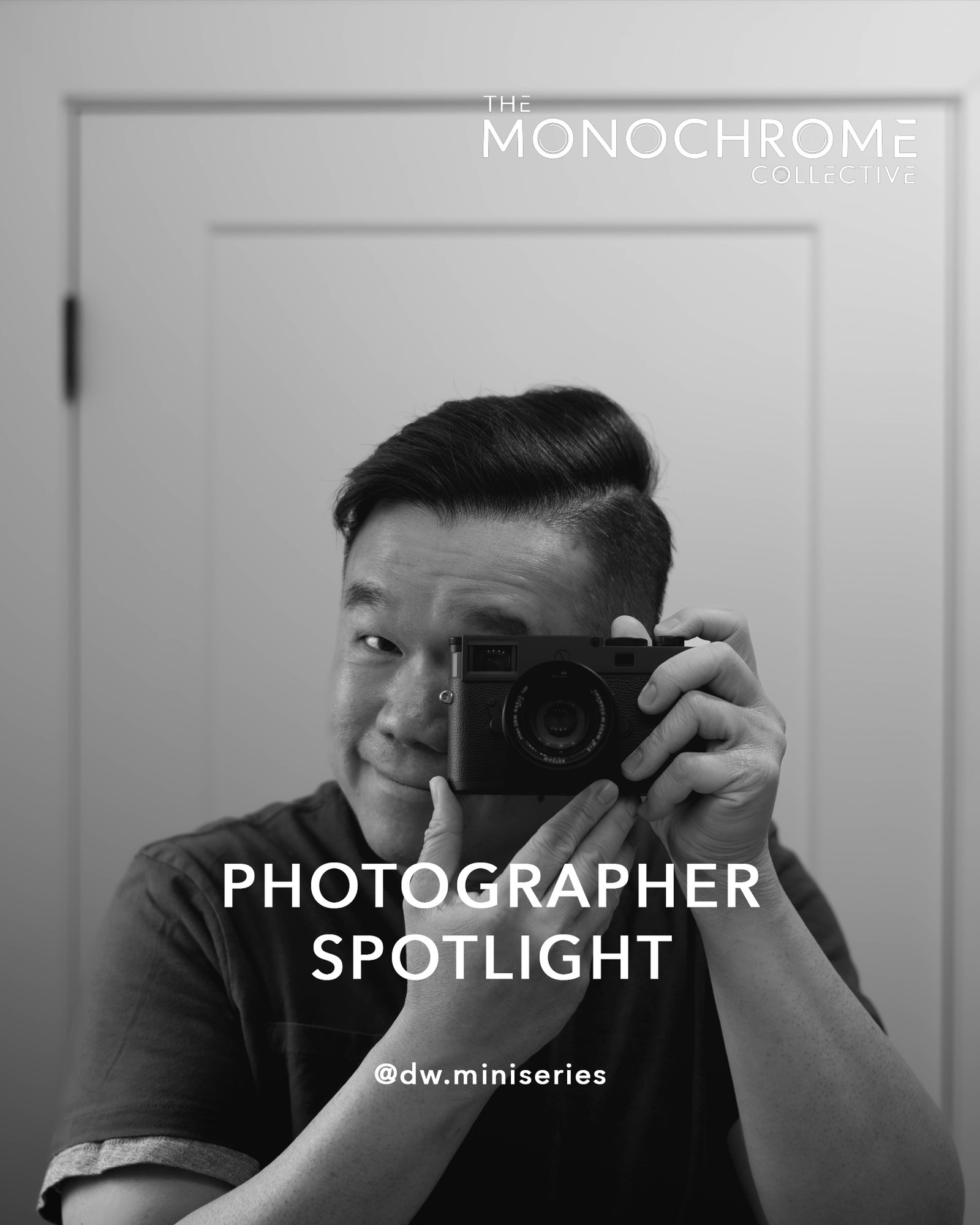
Danny Wong describes himself as quiet and shy, and he traces his interest in photographs back to the family albums he grew up with, which gave him a way of understanding the people around him without having to say much. He did not own a camera until high school, when he bought a point and shoot with money from a part time job and did exactly what the name suggested. What changed everything was meeting his future wife, who taught him the technical side and, more importantly, showed him that a carefully chosen moment could tell a story.
He does not photograph one subject. What he chases is mood, in his own city or somewhere new, and he believes every photograph needs a soul. Black and white was never a decision he made on a particular day. He started in color, still shoots color, and simply found himself coming back to monochrome because it gave him a sense of peace and made him pay closer attention to light, shadow and texture. He works with one body and one lens, a Leica M11 Monochrom and a Minolta M-Rokkor 40mm f/2, plans nothing but the location, and keeps his editing to a crop and a little work on shadows and contrast.
We asked him about the afternoon at Yankee Stadium when he finally found the courage to ask a stranger for a portrait, and why the advice he would give his younger self is to stop looking outward.
Here is our interview:
There’s always a moment that pulls someone into photography for good. What was yours?
I don’t think there was one particular moment that pulled me into photography for good. For me, it happened gradually. I’ve been interested in photographs since I was young. I’m naturally a very quiet and shy person, and when I was growing up, I often found myself understanding my family through the photographs in our family albums. They gave me a way of looking back at people, places, and moments that I might otherwise have forgotten. I didn’t have access to a camera of my own until high school, when I used money from my part-time job to buy a point and shoot. And I did exactly what the name suggested, I pointed it at things and shot, without much knowledge or purpose.
Things changed when I met my future wife. She introduced me to the technical side of photography, from the exposure triangle and composition to color and the editing process. But what really changed was that I began to understand that a photograph could do more than record something. A carefully chosen moment could tell a story. The more I photographed, the more I started paying attention to why I was pressing the shutter in the first place. I think that was the real turning point, when photography stopped being simply something I did and became something I wanted to pursue seriously.
What subjects are the focus of your work and why?
That’s a tough one, because I don’t really have a specific subject. If I had to choose one thing, I would say my biggest focus is mood.
Whether I’m traveling somewhere new or simply walking around my own city, I’m always thinking about how I can bring the mood of a place or a moment into a photograph. It could be the light, the weather, the quietness of a street, a person’s expression, or even something that is difficult to explain. I believe every photograph needs a soul, and for me, mood is one of the ways to bring that soul to life.
Your black and white work has a particular feeling to it. How did you arrive at that? Was it deliberate or did it emerge over time?
It definitely emerged over time. I started photography with color, and I still photograph in color today. But as I continued photographing, I found myself returning to black and white more and more often.
There is something about photographing in black and white that gives me a sense of peace. It removes some of the distractions of color and makes me pay closer attention to light, shadow, texture, and the feeling within a scene. I didn’t make a conscious decision one day that I was going to become a black and white photographer. I think I simply kept coming back to it because it felt more natural to me.
Tell us the story behind one of your favorite photographs.
My favorite photograph doesn’t exist yet. Maybe the next one will be. But there is a photograph I took recently that has a story within a story. For a long time, I’ve wanted to photograph a stranger’s portrait, but I’ve always been too hesitant to walk up to someone and ask. One day, I finally found the courage to do it. We were at Yankee Stadium early, before the crowd had arrived. I noticed a man sitting among the empty seats. I hesitated, as I usually do, but eventually I walked over and asked if I could take his portrait. He said yes. It was a very simple moment. I took the photograph and moved on.
But later that night, while I was editing the image, something unexpected happened. The photograph reminded me of my own story with the Yankees and how I became a Yankees supporter in the first place. So the photograph ended up holding two stories, the story of a stranger I had just met, and a small piece of my own history. That is one of the things I love about photography. Sometimes you don’t fully understand the meaning of a photograph until much later.
What is one thing that you are working to improve in your photography and how are you going about it?
I’m still learning how to see and read my environment better. I think the first reading of a scene is usually the obvious one. What I’m trying to develop is the ability to stay with it a little longer and find something less obvious. I often go back through my own photographs and ask myself why I pressed the shutter at that particular moment, and why I chose that particular angle. Sometimes I understand the decision immediately. Other times, I realize I was simply reacting to what was in front of me.
I also go back to the same locations at different times and continue photographing them. The same place can tell you something completely different depending on the light, weather, time of day, or even your own state of mind. For me, learning photography is still very much about learning how to look.
How much do you plan versus shoot spontaneously?
I used to plan way too much. Sometimes I would spend days planning a shoot before I even put my foot outside the door. I don’t do that anymore. These days, my philosophy is almost just go out and shoot.
Usually, the location is the only thing I plan. When I have some free time, I’ll open Google Maps, look around, find places that seem interesting, and add them to a list. Then, when the weather permits and I get permission from my wife to disappear for an afternoon or evening, I pack my camera and go. I actually enjoy not knowing exactly what I’m going to photograph. The less I plan the photograph, the more room there is for the place itself to surprise me.
What gear do you bring when you go out to shoot?
I’m a one-body, one-lens kind of person. My usual setup is a Leica M11 Monochrom with a Minolta M-Rokkor 40mm f/2. That’s pretty much it. I like having one camera and one focal length with me. It keeps things simple and, perhaps more importantly, keeps me from spending too much time thinking about what gear I should be using instead of what I’m actually seeing.
What does your editing process look like? What tools do you use and how do you approach it?
I’ve used Adobe Lightroom for quite a while, but after the recent price increase, I decided it was no longer something I could justify. I’m using Photomator now, and I’ve found that it suits the way I work quite well. I keep my editing process very simple.
I import the RAW files, then go through everything I photographed that day. The first thing I look at is the crop. Yes, I crop. Please don’t judge me. After that, I work on each photograph individually, mostly adjusting shadows and contrast. That’s usually about it. Once I’m satisfied with the edits, I export the photographs, rename them with the date and camera information, and archive them.
Who are some photographers or artists that have influenced your style and why?
I’m not sure I can say that any particular photographer has influenced my style, because I’m still working very hard to develop my own. But there are photographers whose work and, perhaps more importantly, whose stories I admire. Two that come to mind are Vivian Maier and Greg Girard. I’m drawn to Vivian Maier not only because of her photographs, but because of the way she photographed almost as a private act of observation. She spent decades documenting everyday life while keeping much of her work to herself. Her photographs feel incredibly attentive to ordinary people and ordinary moments. Her story also reminds me that photography doesn’t have to begin with an audience in mind.
Greg Girard is another photographer I admire, particularly for the way he has spent decades documenting cities and their transformation. His work in places such as Tokyo, Hong Kong, and Shanghai shows how a city can become a record of time, not just a collection of buildings and streets. I especially connect with his early photographs of Tokyo, which began from simply walking and photographing the city. So while I wouldn’t say I’m trying to photograph like either of them, I admire the way both have developed a very personal relationship with the places and subjects they photograph.
What would you tell yourself when you started in photography? The thing nobody said to you that would have changed how you photographed?
I would tell myself to stop worrying so much about whether other people liked my photographs. When I first started taking photography more seriously, I think I spent too much time looking outward. I looked at other photographers, their photographs, their equipment, the attention their work received, and the numbers attached to it. Social media makes it very easy to believe that those things are somehow a measure of whether you are becoming a better photographer. I would also tell myself that I didn’t need to keep chasing better equipment. There is always another camera, another lens, another piece of gear that promises to make the next photograph better. But no camera can tell you what to see, and no lens can give a photograph a point of view.
What I really needed was time. Time to photograph. Time to look at my own work. Time to understand why I pressed the shutter when I did, what I was trying to say, and what kept drawing me back to certain kinds of photographs. I would tell my younger self to take inspiration from other photographers, but not to lose himself trying to become one of them. Admire their work. Learn from them. But then put the camera down, go outside, and figure out what you see. I’m still doing that today. I think photography is less about finding a style and more about slowly discovering what you cannot stop photographing. Your own voice is already somewhere in there. You just need to spend enough time listening for it.
If you would like to see more of Danny’s work you can find him on foto @dw.miniseries