Somebody photographed that mountain before you. They photographed it before Ansel Adams too, and nobody told him to go and find a different one.
There’s a piece of advice that circulates in landscape photography and it sounds like rigor. Don’t photograph what has already been photographed. Find your own view. If a thousand people have stood at that overlook, go somewhere else.
It gets said to beginners constantly, usually by people who believe they’re being helpful. And it’s doing more damage than almost any other idea in photography, because people believe it. They look at a picture they were happy with, read a comment saying every tourist has that shot, and quietly conclude their work isn’t any good.
So it’s worth being precise about what’s wrong with it.
It’s been done is not a critique
Look at what that sentence actually contains. Nothing about the tonal separation. Nothing about where the light fell or how the edges were handled. Nothing about whether the picture holds a stranger for four seconds or loses them immediately.
It’s a statement about the subject, and the photographer hears it as a verdict on the photograph. Nobody notices the switch, including the person who made it.
That’s what makes it the laziest judgement available in the medium. You don’t have to look at a photograph to deliver it. You only have to recognize the mountain. It’s also unanswerable, because every subject on earth has been photographed, so the charge always lands and can never be refuted. A criticism that’s always true and requires no looking isn’t a standard. It’s a reflex.
Watkins got there first by half a century
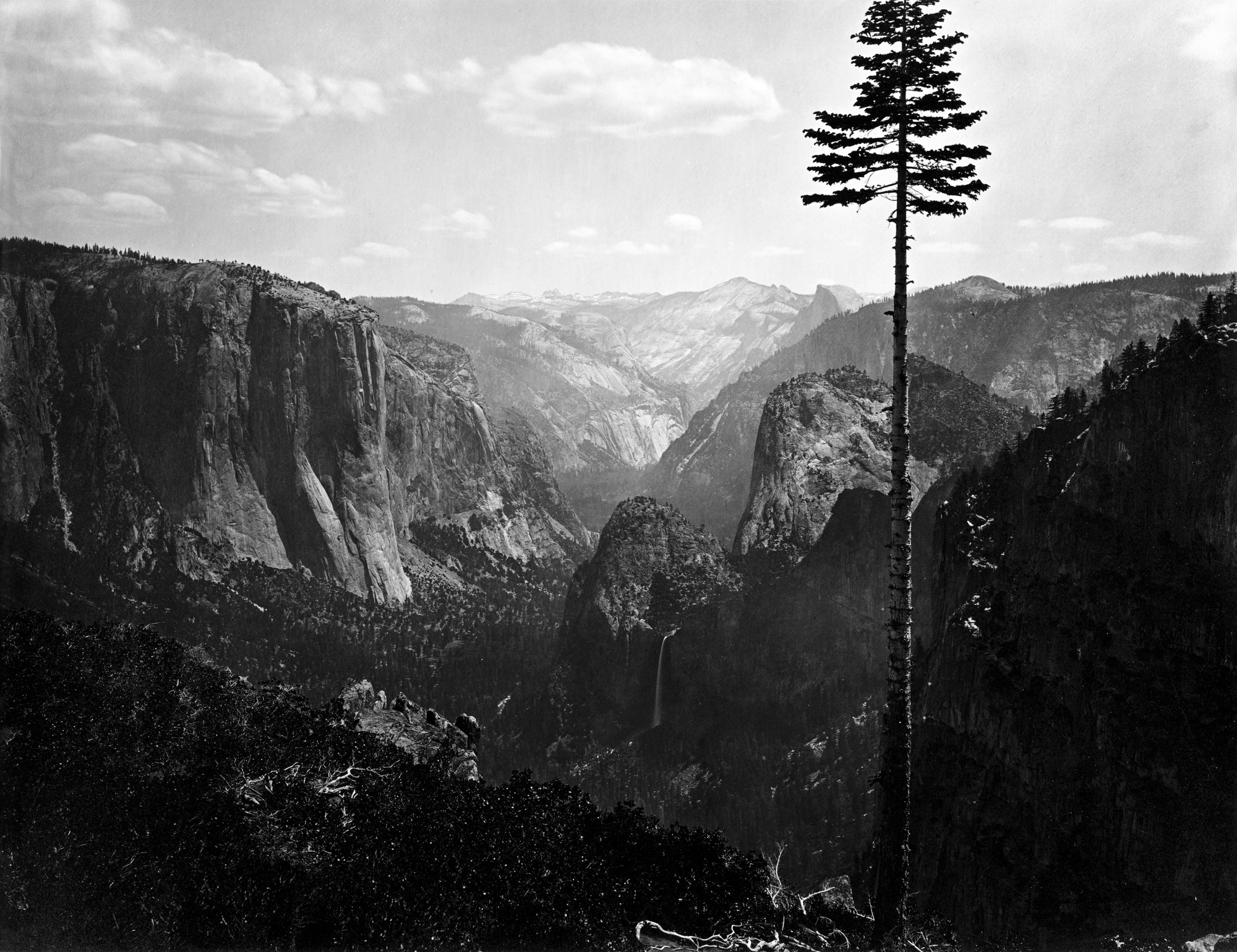
In July 1861 Carleton Watkins hauled a mammoth plate camera into Yosemite by mule, coating glass plates in a tent and exposing them before they dried. He came back with thirty mammoth plates and around a hundred stereographs. Those pictures went to Washington, and in 1864 Congress protected the valley. Photographs did that.
Ansel Adams first photographed Yosemite in 1916, as a fourteen year old with a box camera. He was fifty five years late. The valley had been photographed exhaustively, publicly, and extremely well, by a man whose work had already changed federal law.
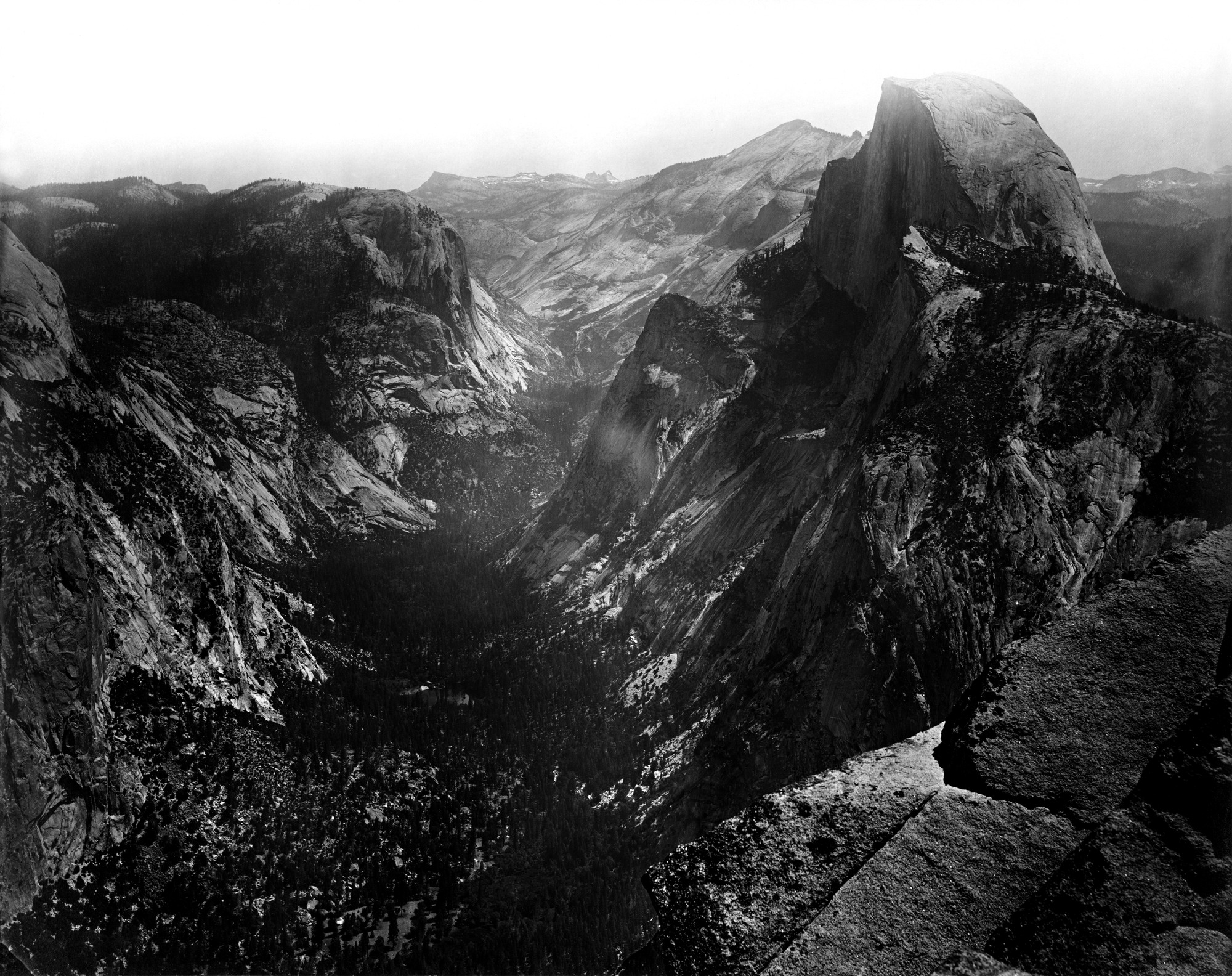
Adams went on photographing that rock for the rest of his life. One of the best known results puts a snowed apple orchard between the viewer and the mountain, so that Half Dome sits behind a tangle of frozen branches and turns up almost incidentally. Watkins, seventy years earlier, had given you the whole valley from Glacier Point and the scale of the thing. One is a description of a place. The other is a season and a weather front with a mountain in it.
Nobody would mistake one for the other. And the subject contributed nothing to that difference, because the subject is identical. Everything that separates those two photographs happened in the photographer.
None of which is a knock on Adams. His Yosemite work is as good as everyone says it is, and he is not a lesser photographer for having arrived after somebody else. That is exactly the point. He made those pictures on a subject that had already been worked for fifty years by people who were very good at it, and they lost nothing by being late. If novelty of subject were the measure, the most admired landscape photographs in America would be disqualified on a technicality.
No other art does this to itself
Cézanne painted Mont Sainte Victoire over and over for the last decades of his life. Monet worked the same haystacks through changing light and the series is the point of it. Hokusai made view after view of Fuji. In painting, returning to one subject repeatedly is read as evidence of a serious practice, a mind going deeper into something rather than skating across it.
Photography treats the identical behaviour as a failure of imagination, and nobody has ever explained why. Part of it is that we’ve spent most of our history arguing we’re artists at all, and a medium that feels accused tends to overcorrect. If the machine does the recording, then novelty starts to look like the only available proof that a person was involved.
Landscape gets it worst, and it’s not your fault
There’s a structural unfairness in who gets accused. A street photograph is unrepeatable by definition, because the moment dissolves as it happens and nobody can stand in it again. A mountain holds still for ten thousand years and has a car park.
So landscape photographers get told to find something nobody has shot, about the one category of subject that physically cannot be new. That’s not a criticism of the work. It’s a fact about geology being mistaken for one.
Your subject is not your photograph
Here’s the distinction the whole argument turns on, and once you have it the advice stops working on you.
Novelty is a property of the subject. Originality is a property of the photographer. The first is finite, discoverable and very nearly used up, which is why chasing it produces gimmicks. The second has no limit, can’t be aimed at directly, and accumulates whether you’re thinking about it or not.
Which means the two things people collapse together are actually independent. Your photograph from that overlook can be flat and obvious, or it can stop someone in their tracks. How many people stood there before you tells you nothing whatsoever about which one you made. We’ve argued the photographer’s side of this when we said to take the cliché photograph anyway, and that originality is a bad definition of creativity. This is the other half. The advice isn’t just incomplete. On its own terms it’s empty.
A filter you can use immediately
When feedback arrives, ask one question about it. Does this name something inside the frame?
The shadow on the left is doing nothing. The horizon sits awkwardly against that ridge. The eye goes to the bright corner and stays there. All of that is somebody engaging with your photograph, and all of it is worth having even when it stings.
Everyone has that shot. That’s been done to death. You’d need a fresh angle on this. None of those required the speaker to look at your picture at all. They’re about the mountain, and the mountain was never the thing you made.
Watkins got there first by half a century and it cost Adams nothing. It isn’t going to cost you anything either.
Photographs by Carleton Watkins are in the public domain. Ansel Adams’s are not. They are controlled by the Ansel Adams Publishing Rights Trust, which is why none of them appear here.