
Five changes that will do more for our night photographs than any piece of gear.
Night is the condition most photographers avoid and the one that rewards black and white the most. The light after dark is already doing what we spend our daylight hours trying to force. It leaves most of the frame alone. It separates a subject from its background without any help from us.
What makes night difficult isn’t the darkness. It’s that almost everything our camera does automatically is wrong after sunset. The meter is wrong, the autofocus is wrong, and our own instinct to brighten things until we can see is the most wrong of all.
Here are five changes that fix it.
Meter the light, not the scene
This is the single change that fixes most people’s night photographs, and it is worth understanding why rather than simply doing it.
Every camera meter has one goal. It looks at the scene, averages what it finds, and tries to turn that average into middle gray. In daylight the assumption behind that is roughly sound, because daylight is broadly even and most scenes really do average out somewhere near the middle. After dark it collapses. A night frame is mostly black with a few small, very bright patches, and the average of that is nowhere near middle gray. The meter doesn’t know it’s looking at night. It thinks it’s looking at an underexposed day.
So it does what it was built to do. It opens up. It adds two or three stops trying to drag that dark average toward the middle, and we get the photograph everybody has taken. The street lamps are blown out to featureless white discs with no bulb anywhere inside them. The shadows have lifted into a flat gray mud that is neither dark nor light nor anything at all. The picture looks nothing like the street we were standing in.
The fix is to stop metering the scene. Switch to spot metering, put the spot on the brightest thing we want to keep texture in, and expose for that. Not the brightest thing in the frame, the brightest thing we want to keep. A bare bulb can go pure white and nobody minds. A lit face, a shop window with goods in it, the illuminated side of a wet road, those have to hold detail, so those are what we meter.
Everything else then falls where it falls, and where it falls is dark. That is correct. We are not trying to expose the night. We are trying to expose the small part of it that has light on it.
Our meter was never really built for us in any light. Night is where that stops being an interesting idea and becomes a practical problem we have to solve on every frame.
Protect the black, because it is the subject
Once the exposure is right, the next thing that goes wrong is us.
There is a strong instinct, in the field and again at the computer, to brighten a night photograph until we can see into the corners. It feels like diligence. It is the fastest way to ruin the frame.
The black in a night photograph is not missing information. It is the composition. A single lit doorway reads as a lit doorway only because there are forty feet of nothing on either side of it. Lift that nothing to a visible gray and the doorway stops being an event. We have taken the thing that gave the picture its structure and turned it into background.
Night hands us negative space in quantities we could never arrange at noon. Three quarters of a frame can be pure black, and in black and white that is not an absence, it is a shape. It has edges, where the light stops. It has weight. It pushes the eye toward the one part of the picture we wanted looked at. Daylight almost never gives us that for free.
So the discipline runs in two places. In the field, expose for the light and let the dark go dark. Then at the computer, leave it alone. The histogram of a correct night photograph is piled hard against the left wall with a thin tail reaching to the right, and that is not a fault waiting to be corrected. Lifting those shadows adds noise in the one part of the frame where noise has nothing to hide behind, and trades a true black for a muddy gray that helps nobody. If something genuinely needs to be visible, the answer was to light it or to stand somewhere else, not to drag it up afterward.
We have made the case for underexposure on its own before. At night it stops being a stylistic choice and becomes the whole method.
Shoot the transition as well as the dark
Night photography sounds like full dark, and full dark is only one of the two nights available to us.
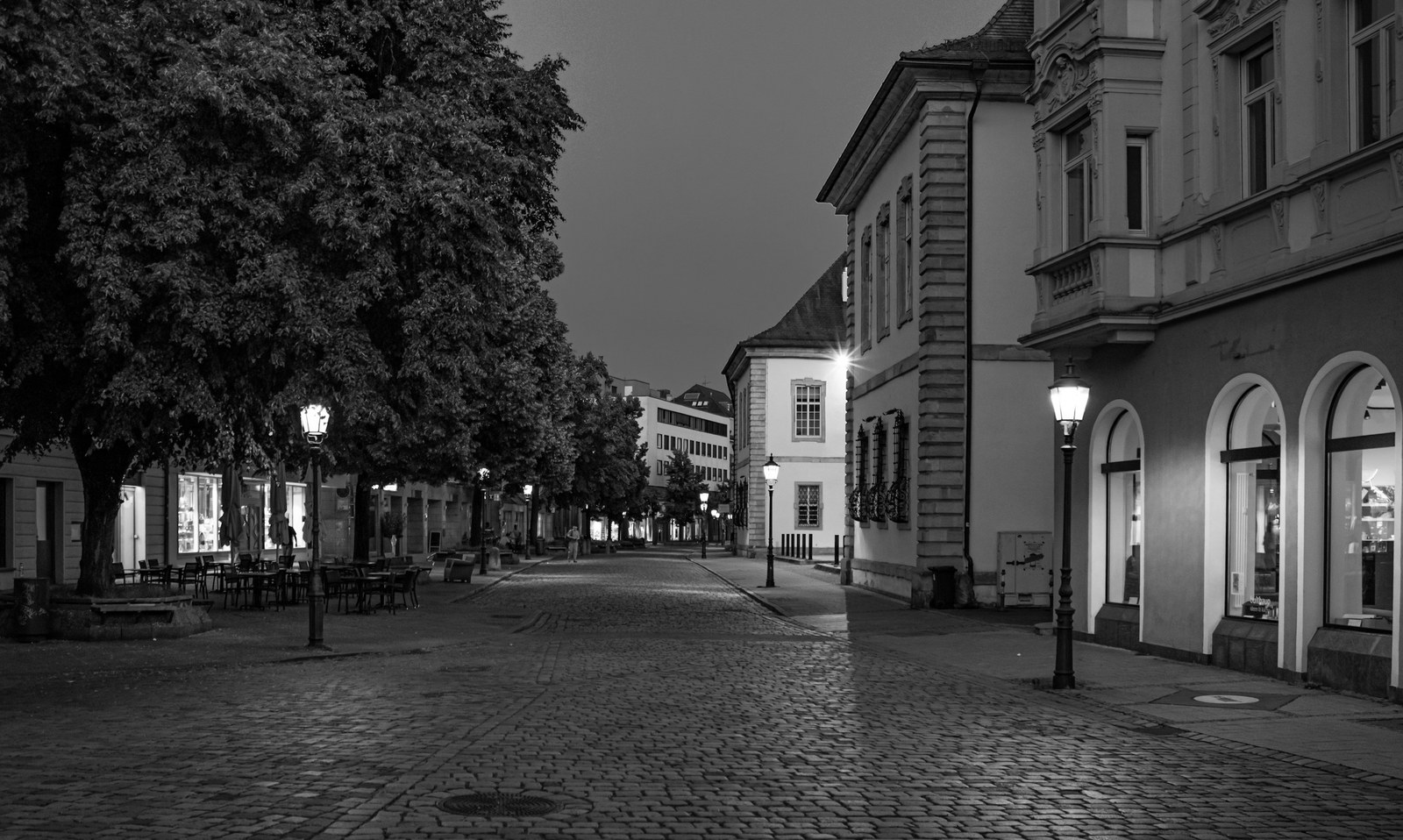
For twenty or thirty minutes after sunset there is a window when two light sources are running at once. The sky still carries enough luminance to render as a mid gray, and the street lights have already come on. That combination does something full dark cannot. It separates sky from buildings. Rooflines read as a crisp edge against a tone instead of dissolving into the same black as the wall underneath them. A tree keeps both its silhouette and its structure. Clouds still have shape.
Once the sky has gone fully black it becomes a hole in the top of the picture. Sometimes that is exactly what we want, because a hole is a strong graphic element and it forces everything down into the lit third of the frame. But it is a different photograph, and it is not automatically the better one. A skyline wants the transition. A single figure in an alley wants full dark.
The practical consequence is to arrive earlier than feels necessary and to keep working after the good light appears to have gone. The window moves fast. Fifteen minutes after sunset the sky is a light gray and the lamps barely register against it. Forty minutes after sunset the lamps dominate and the sky is nearly gone. Those are two completely different photographs of the same street, half an hour apart, and the only way to have both is to still be standing there.
Solve focus before we need it
Autofocus is the first thing to fail after dark. It needs contrast to work and there isn’t much, so it hunts, racks back and forth, and then locks onto the brightest point in the frame rather than the thing we were actually pointing at. By the time it settles, whoever was walking through our pool of light has walked out of it.
The answer is to stop asking it. Zone focus instead. Set the lens to a fixed distance, choose an aperture, and know in advance the band of the scene that will be acceptably sharp. The camera then has no decision left to make and neither do we. We press the shutter when the picture happens.
Night suits this better than daylight does. Zone focusing in daylight asks us to estimate distances while moving, which takes real practice. At night we are not moving. We have found a lit area, we have chosen where to stand, and the thing we are photographing is going to arrive at a known place, because that is the only place with light on it. The distance has already been decided for us. We can set the lens once and leave it.
Two things make it easier. Set the distance by focusing on something standing in the lit area while we still can, then switch to manual and don’t touch the ring again. And expect a narrower zone than daylight would give us, because the aperture is going to be wide. At f/2 the band of sharpness is thin, so the patch of light we picked has to be where the subject will actually walk.
What to actually look for
Everything above is how to make the exposure. This is the part that decides whether there was a photograph there at all.
Night does not hand us subjects. It hands us light sources, and the craft is knowing what each one does.
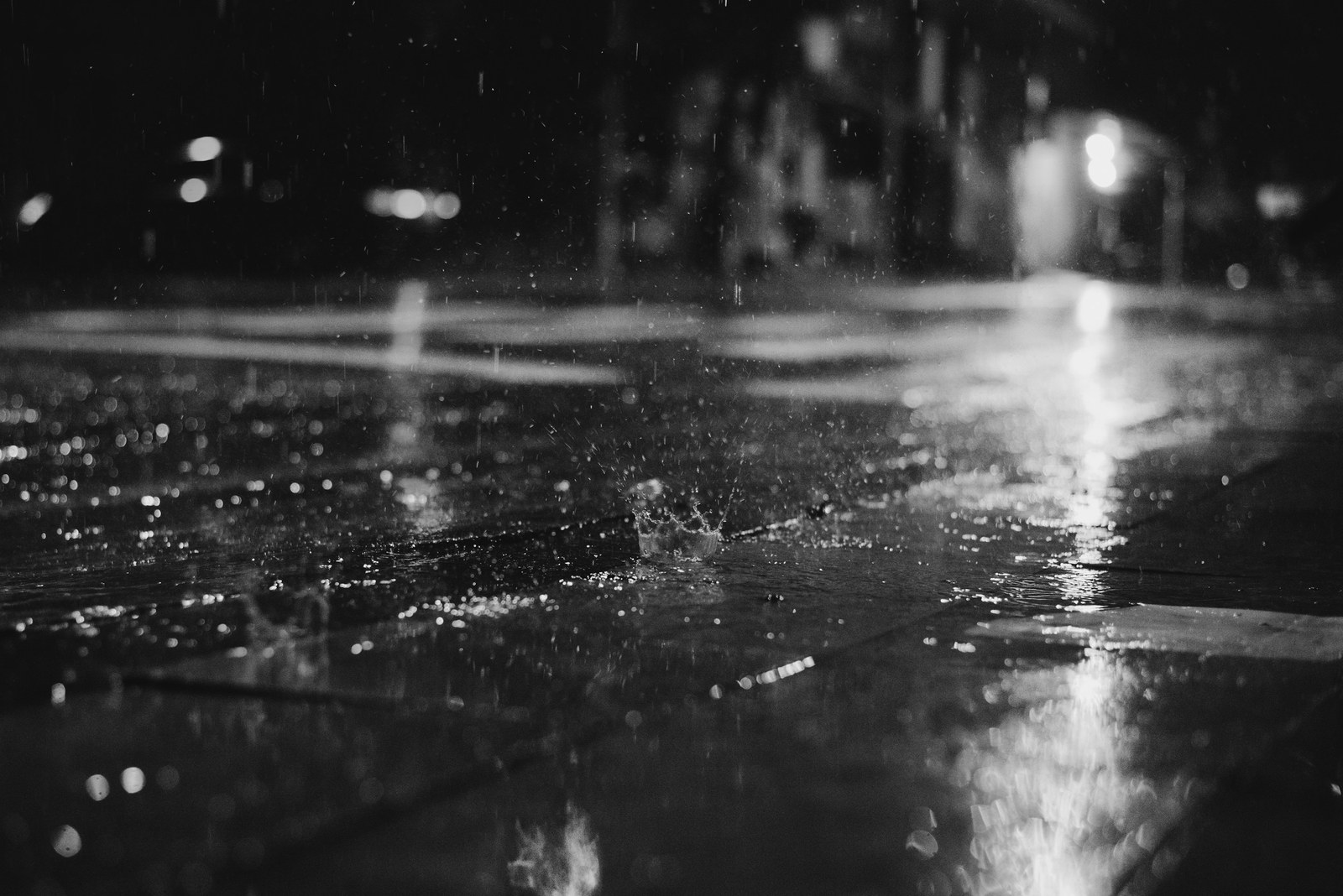
Wet pavement. Rain is the most generous thing that can happen to a night photographer. Wet asphalt doubles every light source in the frame and stretches each one into a vertical streak running toward us. A street with six lamps becomes a street with twelve. Work during the rain, or in the half hour after it stops and before the road dries.
Fog. Fog makes a beam visible. A street lamp in clear air is a bright point with a lit circle underneath it. The same lamp in fog is a solid cone of light hanging in the air, which is a shape we can compose with. Fog also deletes the background, which solves the hardest problem in night photography and asks nothing in return.
Shop windows. A lit shop window is a softbox the size of a wall, and it is the best portrait light on any street. Soft, directional, and it falls off fast. Stand somebody just inside its throw and we have studio lighting we didn’t have to carry.
One lit window in a dark facade. The simplest night photograph there is. A single rectangle of light in a black wall, with or without a figure inside it. It works entirely because of the ratio, and the ratio is the picture.
Steam and exhaust. A vent, a manhole, a kitchen extractor. Steam catches light from below and glows, and it keeps moving, so no two frames of it are the same.
Interiors going past. A bus, a tram, a lit train carriage. The inside of a bus at night is brighter than anything on the street, and it carries people arranged in rows, all looking in different directions. It is there for about two seconds, which is why the focus has to be set already.
Where to go this week
Pick one street with lamps on it and go twice. Once about fifteen minutes after sunset, once two hours later. Same street, same lens, zone focused at the same distance both times. Spot meter the lit areas, and refuse to lift anything afterward.
Two sets of photographs from the same hundred yards of pavement. The difference between them will say more about how night actually works than this article can.