It depends entirely on what we mean by bad. One kind disappears. The other gets worse.
It’s a question that comes up constantly and gets answered badly in both directions. Half the people say yes, monochrome is forgiving, shoot in anything. The other half say no, light is light, the rules don’t change. Both are right about something and neither is much use, because bad light isn’t one thing. It’s two, and they behave in opposite ways the moment the color comes out.
Two different problems with the same name
The first kind is mixed light. Mixed sources, color casts, hues that fight each other. A room lit by a tungsten bulb overhead, cold daylight coming through one window, a television in the corner and a fluorescent tube out in the hall. Nothing is wrong with the shape of that light. What’s wrong is its color.
The second kind is flat light. Directionless, coming from everywhere and therefore from nowhere. A gray overcast afternoon with no shadow anywhere in the frame. The color is fine. There just isn’t any structure in it.
We call both of them bad light, and they’re worth separating, because they have almost nothing in common except that we don’t like standing in either. Black and white treats them completely differently.
The first kind genuinely does disappear
Take the colors out of that mixed room and the problem doesn’t get solved. It stops existing. The tungsten, the daylight, the television and the fluorescent all collapse into one scale of light and dark, and what was an argument between four sources becomes a single question of which parts are brighter than which.
Same with a green bounce off grass landing on somebody’s cheek, or a magenta wall throwing color where nobody wanted it, or a scene whose palette simply clashes. Those are failures of hue, and monochrome deletes hue. So for that whole category the answer is an honest yes. Black and white doesn’t just forgive mixed light, it makes the question meaningless.
The second kind gets harder, not easier
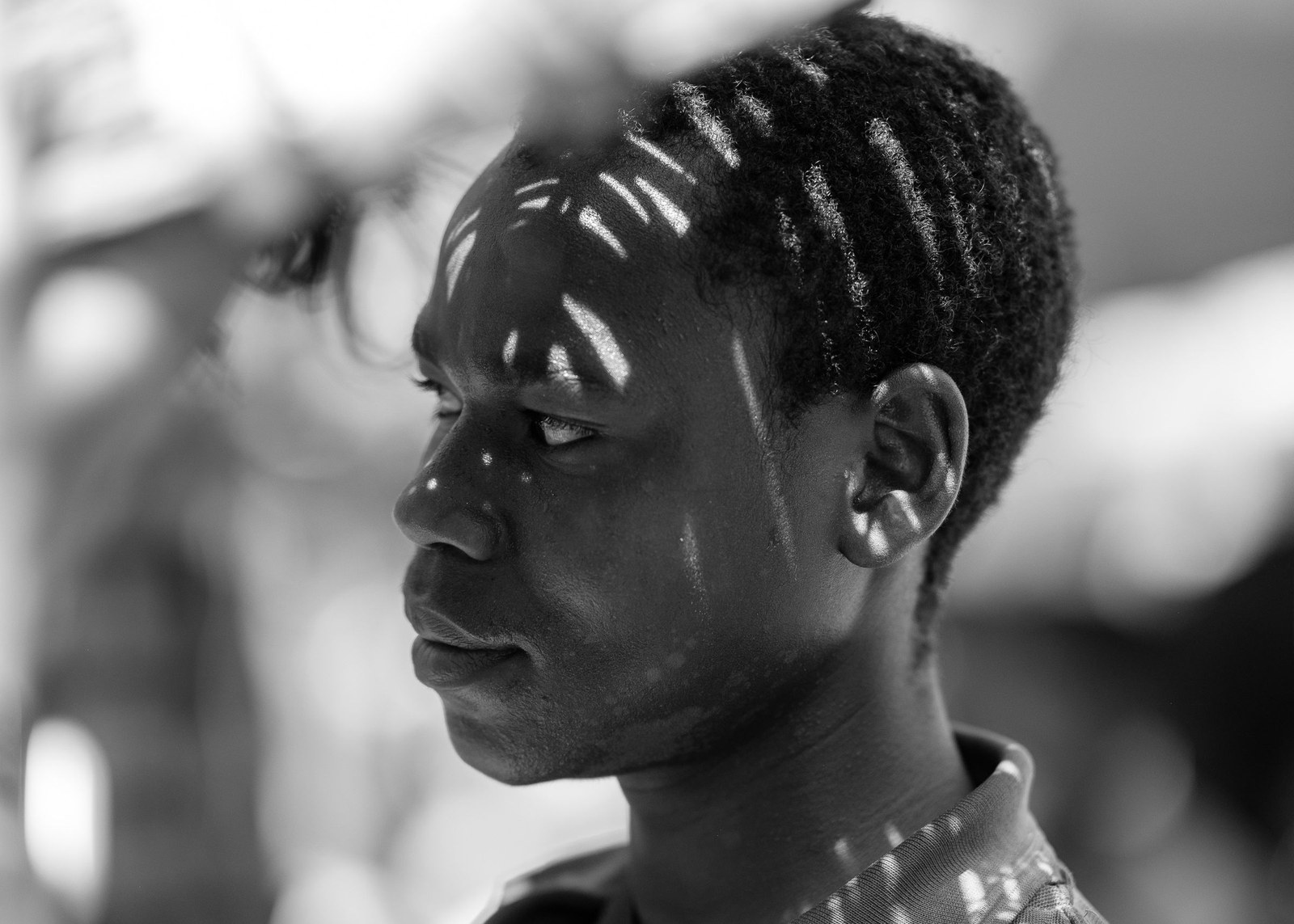
Flat light in color still has something to offer. A market stall on a gray morning is carried by the reds and the yellows, and nobody minds that the light is doing nothing, because the color is doing it instead. Take that away and look at what’s left. No shadow to describe a shape, no falloff across a face, no separation between a person and the wall behind them.
That last one is the killer. A red coat stands clear of green foliage in color even when the two are identical in brightness, because hue is doing the separating. Convert it and they become the same gray and merge into one shape, which is the whole reason we talk about building a picture from the back and about what the eye lands on first. In color there was a safety net. In monochrome there isn’t one, and flat light is precisely the condition that gives us nothing to replace it with.
Which is why it can’t be used as an excuse
Everybody knows the move. A frame didn’t work, so we try it in black and white, and every so often it comes alive. That’s a legitimate thing to do and it has rescued plenty of good photographs. It works for exactly one reason, which is that the problem was chromatic all along.
The trouble is the habit it quietly builds. Once we’ve seen the conversion save a few frames, it starts operating as a second chance sitting there in the back of the mind, and a second chance makes us less careful the first time. We stop watching the light as closely as we would if the file had to stand up in color, because some part of us has already decided monochrome will sort it out.
It won’t. Choosing black and white doesn’t exempt anybody from light. If anything it raises the stakes, because tone is the only instrument left once hue has gone, and tone comes directly from how the light falls. Quality and direction are the whole game. They were always the whole game, and in monochrome there is nothing standing in front of them.
What to watch for while standing there
The useful question in front of a scene isn’t whether the colors are wrong, because that one answers itself and monochrome handles it. It’s whether the light is actually doing anything at all. Is there a direction to it. Is anything being modeled. Is there a shadow somewhere describing the shape of a thing rather than just sitting underneath it. Does the subject come away from its background on brightness alone, which is a question we can answer before touching a single setting.
If the answer to all of that is no, converting won’t help. A flat frame in color becomes a flat frame in gray, and the gray version is actually usually worse, because we have taken away the one thing that was carrying it.
So the honest answer to the question is a split one. Black and white forgives the light that is the wrong color, completely and without argument. It forgives nothing at all about light that has no shape. Knowing which of those we’re standing in is most of the skill, and reaching for the conversion before we’ve asked is how a lot of ordinary photographs get made.