One Saturday morning, more than thirty metro stations closed, about two hours of walking. Six photographs came out of it, and the city is arguing with itself in every one.
The sign came before the event
RV had to plan the trip, because more than thirty metro stations were closed across Paris that morning. She came from home in another part of town and came up at Filles du Calvaire at 9:45. The Ricoh GR Cities event started at ten and she wanted to be on time.
A block or two from the station she found it. A board propped low against a wall at knee height, hand painted, the letters running into each other. Ils nous gaz car ils ont peur. They gas us, because they’re afraid. She thinks the letters were orange on white, though she was carrying a monochrome camera and had no way to check. Fallen autumn leaves were strewn all about it. There was nobody on the street.
She calls it a determined but serene message, and that is close to exactly what the frame looks like. A quiet shopfront, the Haussmann buildings opposite caught in the glass, a man walking past with his eyes on his phone, and a sentence at ankle height that nobody is reading.
She made a frame or two and carried on to the event.
Then she left the group
The event ran for an hour, talks by a few well known Ricoh GR photographers, and afterward there was a group photo walk. She left as soon as the talks finished.
She did not want to walk in a group. She wanted to walk alone, and more than that she wanted to go back to the sign and make a better picture of it. The series exists because of that decision. Walking the same street again, slowly, she saw everything she had gone straight past an hour earlier.
Boarded up, and proclaiming to be open
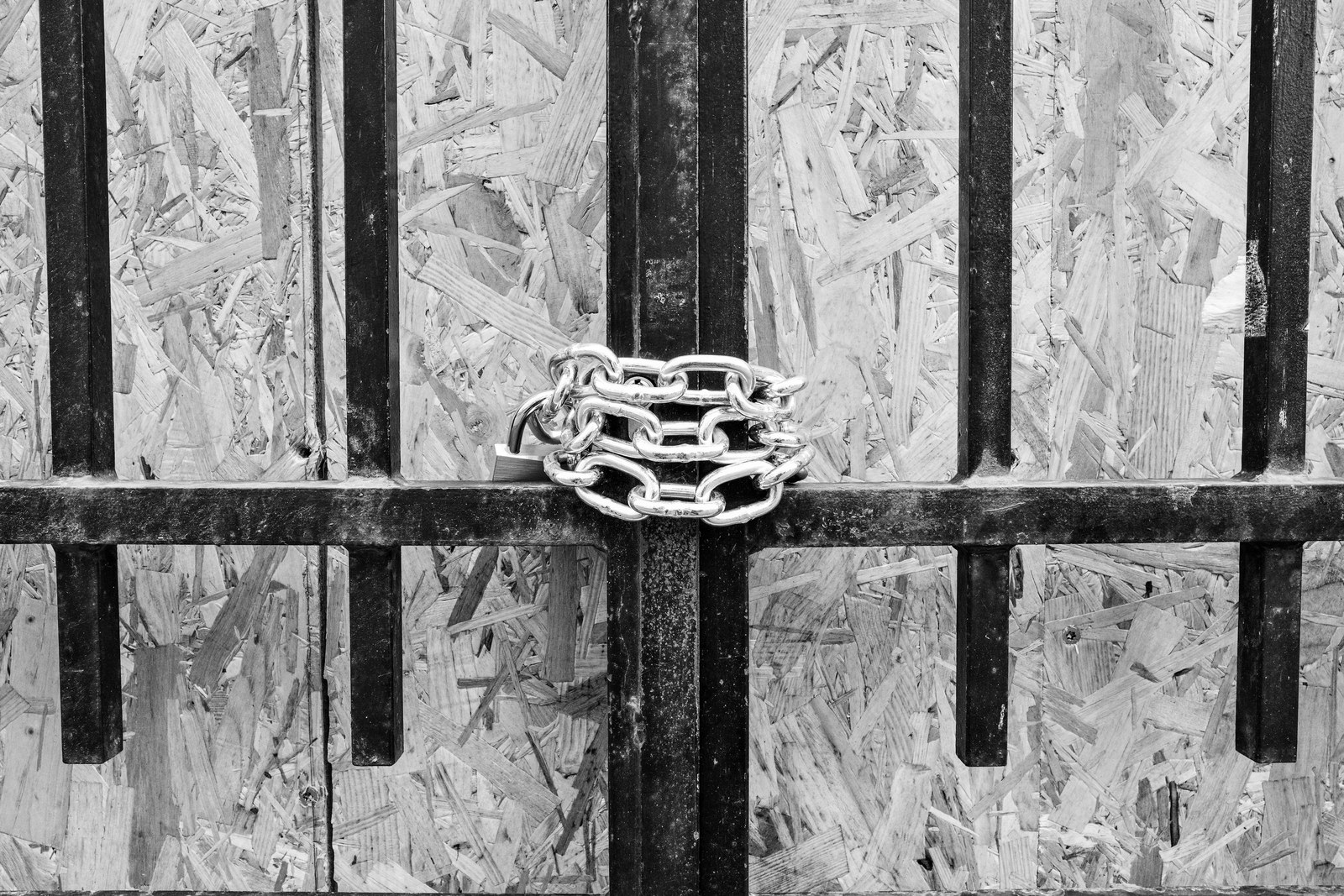
This is a part of Paris that on a normal Saturday morning is full of people going about their lives. It was very quiet and very tense. Plywood over the windows, the raw chipboard kind that goes up fast. Gates pulled down and chained shut.
And then, stapled to the boards across one shopfront, two printed signs reading OPEN, the door standing ajar and somebody waiting inside in the dark.
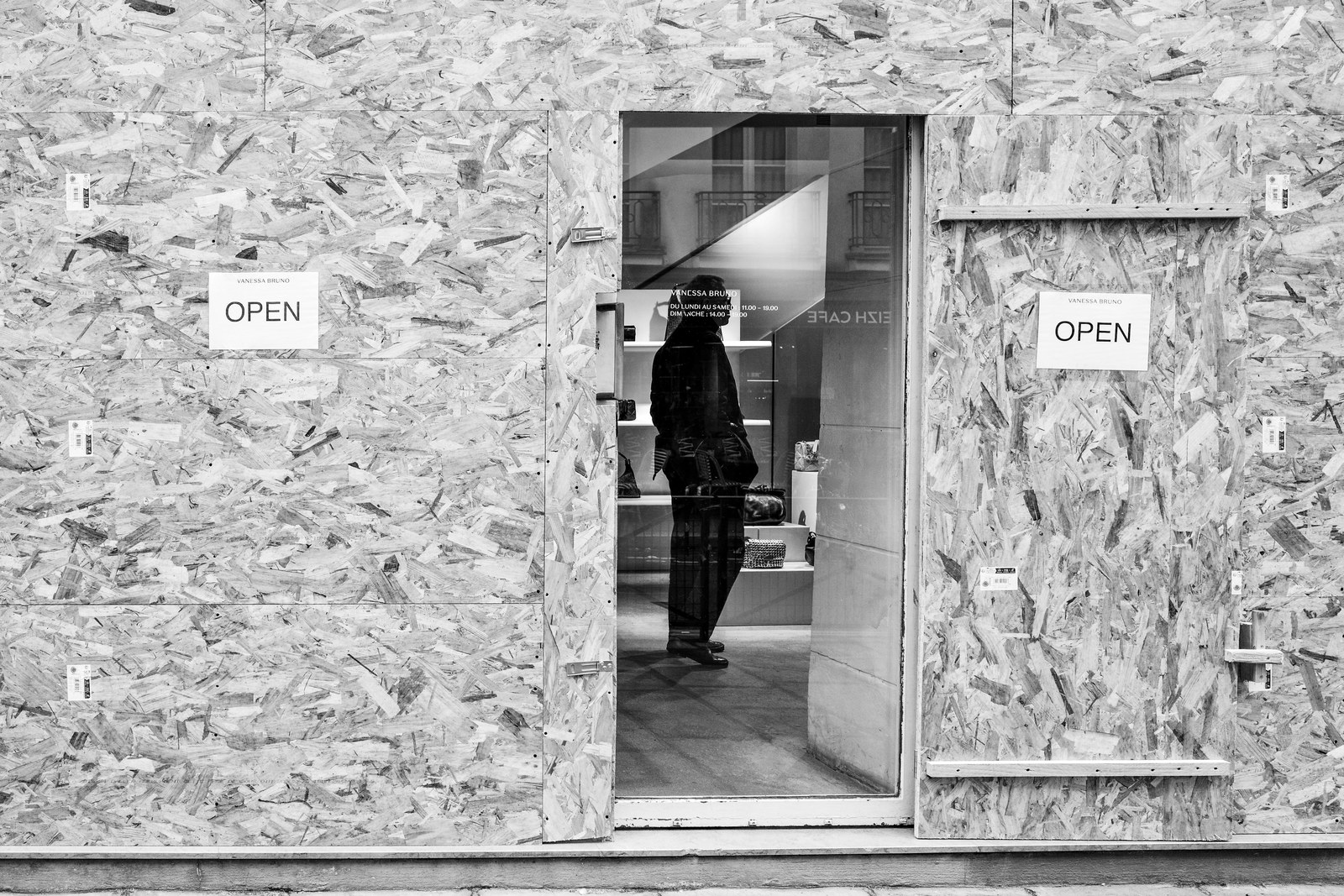
That contradiction is what she kept finding all morning, and it is the spine of the series. Places boarded up but insisting they were open. Signs of closure and fear a few feet from words of resistance and solidarity.
The walls were doing the talking
With almost nobody out, the writing on the buildings was the only voice on the street.
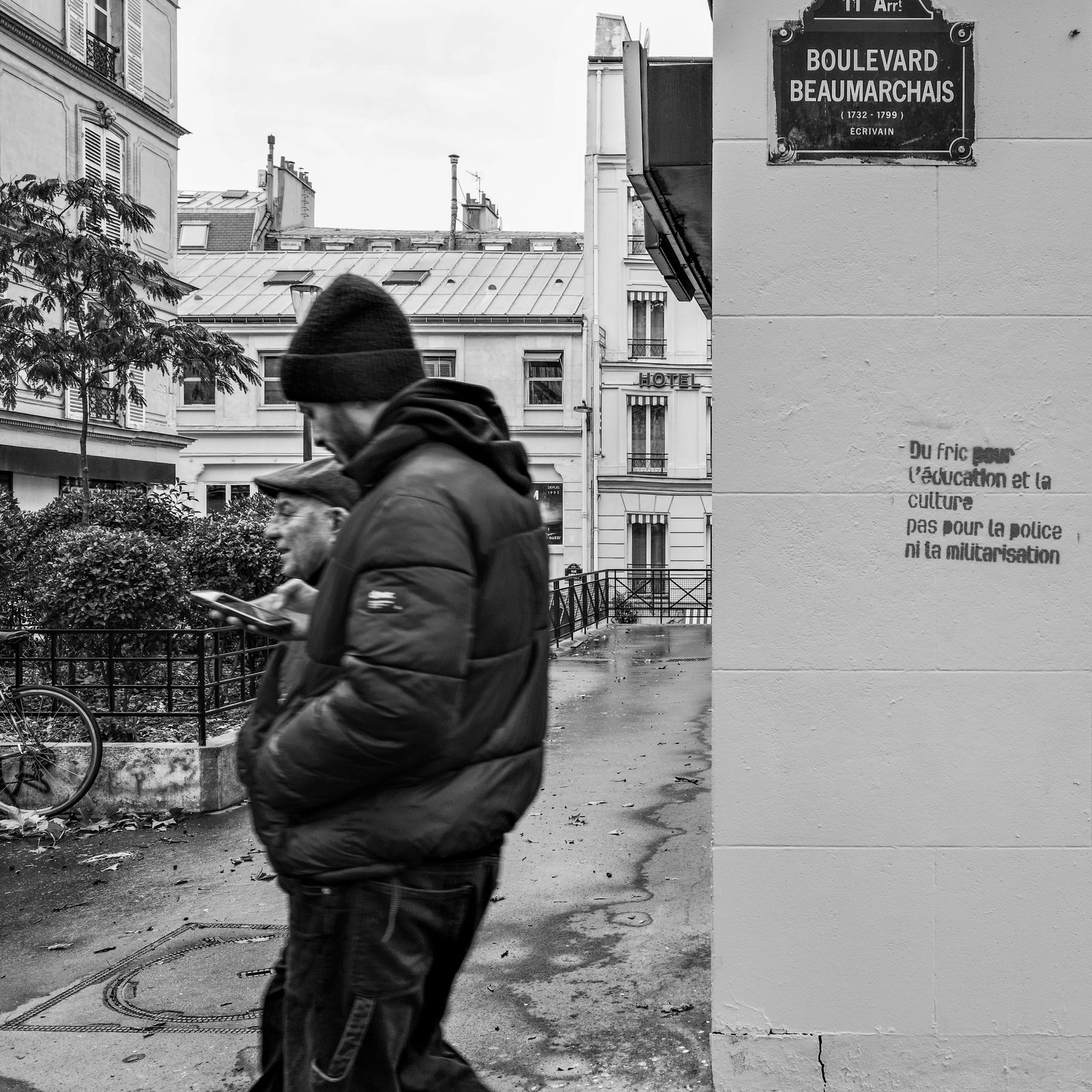
On the corner of Boulevard Beaumarchais, stenciled onto clean pale stone just below the street sign. Du fric pour l’éducation et la culture, pas pour la police ni ta militarisation. Money for education and culture, not for the police or your militarization. Two men walk past it in her frame without looking up.
On the boards it was blunter. Mort du macronisme, painted upside down. A circled A. Paris Antifa. Elsewhere that week she had read the lines that stayed with her afterward. Support to the students. Our lives against their wealth. If you 49.3 us, we’ll May 68 you. Article 49.3 is the clause that lets a French government push a law through without a vote, and in Paris May 68 needs no explaining.
A Saturday morning that was not one
The franprix was open. Lights on, shelves stocked, a member of staff at the back. Immediately beside it a boarded window carrying Paris Antifa and a circled A, and an elderly woman going past in a long coat with her stick and a small white dog, entirely unbothered by any of it.
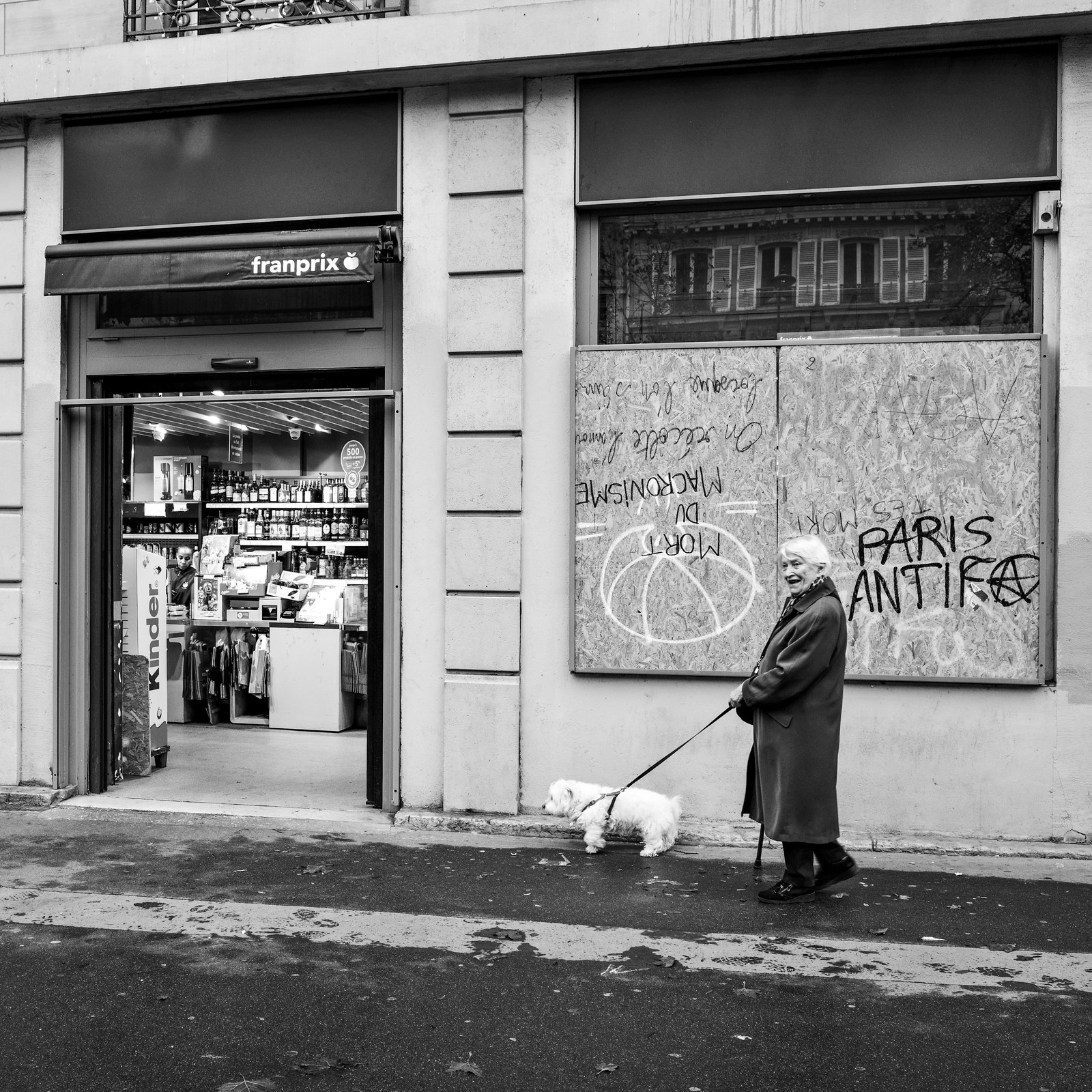
It is the quietest photograph in the set and probably the most useful one. Nothing in it is dramatic. A shop is open, a neighbor is walking her dog, and the wall behind them has been boarded over and written on. Both things are true in the same moment and neither one cancels the other.
Down to Bastille, where nothing was allowed to happen
From there she wandered all the way down to Bastille and back. Bastille was where the day’s major demonstration was supposed to start at two in the afternoon, and the police had just banned it. People who turned up for the march were being fined 135 euros.
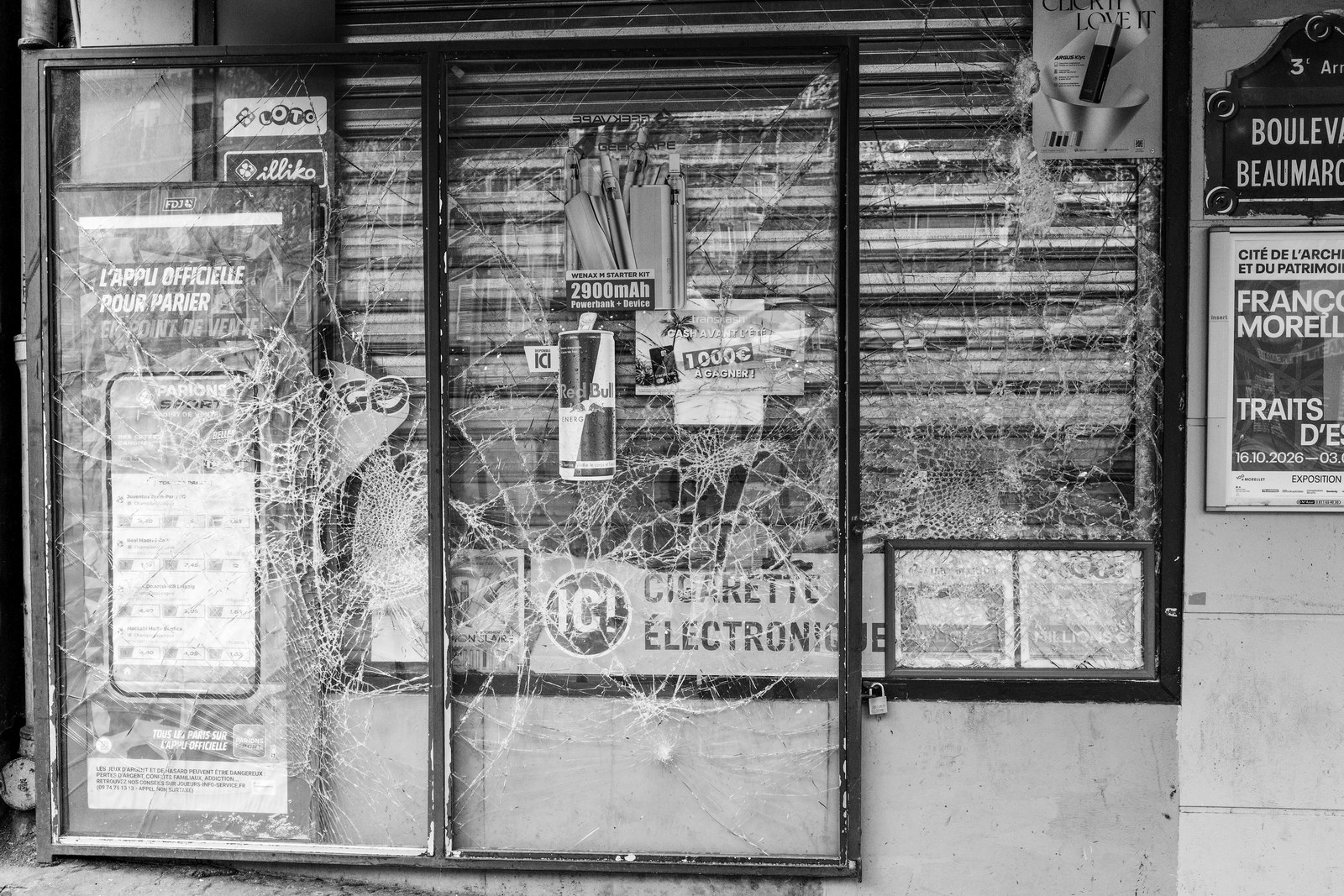
On the way, a tabac with its entire frontage spiderwebbed and caved in, the lottery terminals and the advertising still perfectly legible behind the broken glass. Somebody had padlocked what was left of it.
She did not speak to anyone
Asked whether she talked to people that day, whether anyone shared their story with her, her answer was short. She was observing.
That is worth taking at face value rather than reading as a gap. She is an NGO researcher who photographs in her free time, she had come out for a camera meetup, and what she made is a photographer’s record of how a neighborhood looked seven days after a bad night. It is not reporting and it does not claim to be. The pictures carry what the street was showing to anyone who walked down it.
Two accounts of the same week
What she was carrying while she walked was the argument, which she says was ringing in her head the whole time.
Mainstream media were talking about violence and looters. Social and independent media gave a different account, of peaceful marches, students explaining their demands, a lot of song and creativity, and young people on the receiving end of police attacks. Some voices were mourning a breakdown of law and order. Others were pointing to France as an inspiration for people facing the same problems with education, housing and the cost of living somewhere else.
Both were describing the same week. Walking through it, it is easy to see why each account found what it was looking for. The boards and the broken glass were real. So was everything painted over them.
What she wanted people to feel
When she shared the pictures on foto, she wanted people to feel the tension in the streets and also the defiance. The quiet was not calm. A neighborhood that is normally full of people on a Saturday morning had gone silent, and in that silence you could read, on every surface, exactly what the people who live there thought about why.
The contrasts, she says, were just striking.
You can see more of RV’s work on foto @vrv
RV is an NGO researcher who lives in Paris and photographs in her free time. She made these photographs on and around Boulevard Beaumarchais on Saturday 24 October 2026, one week after the night of 17 October.