
Actors hold two goals at once. The second is what turns good frames into a body of work.
An actor learning a part is taught to answer two questions rather than one, and to keep both answers live at the same time.
The first is small and local. In this scene, right now, what does my character want? Not how do they feel and not what mood they are in, but what are they trying to get. This is the objective, and the craft is strict about the grammar of it. An objective is a verb. To persuade her to stay. To get out of the room without being asked where I have been. To make him admit he was wrong. None of those is an adjective, and that matters, because to be sad isn’t something an actor can do. It can only be indicated, which is why indicated sadness looks like bad acting.
The second question is the large one. Across the whole play, what is this character after? That one is the super objective, and the two get described as a spine and its vertebrae. Each scene is a single bone. The spine is what makes them a body rather than a pile.
What the small question looks like with a camera
Standing in front of something, what is this photograph trying to do? That translates almost directly, and most of us answer it the way a beginning actor does, by naming a mood instead of a verb. I want it to feel lonely. I want it to be moody. Neither of those is something anybody can execute.
Turn them into verbs and they get useful immediately. To show how much empty room there is around him. To make someone notice the gap before they notice the face. To separate the one lit thing from everything behind it. Those can be done, and more usefully they can be checked afterwards. You can look at the frame and say plainly whether it happened. A mood can always be argued about. A verb either landed or it didn’t.
The large question is about the body of work, not the frame
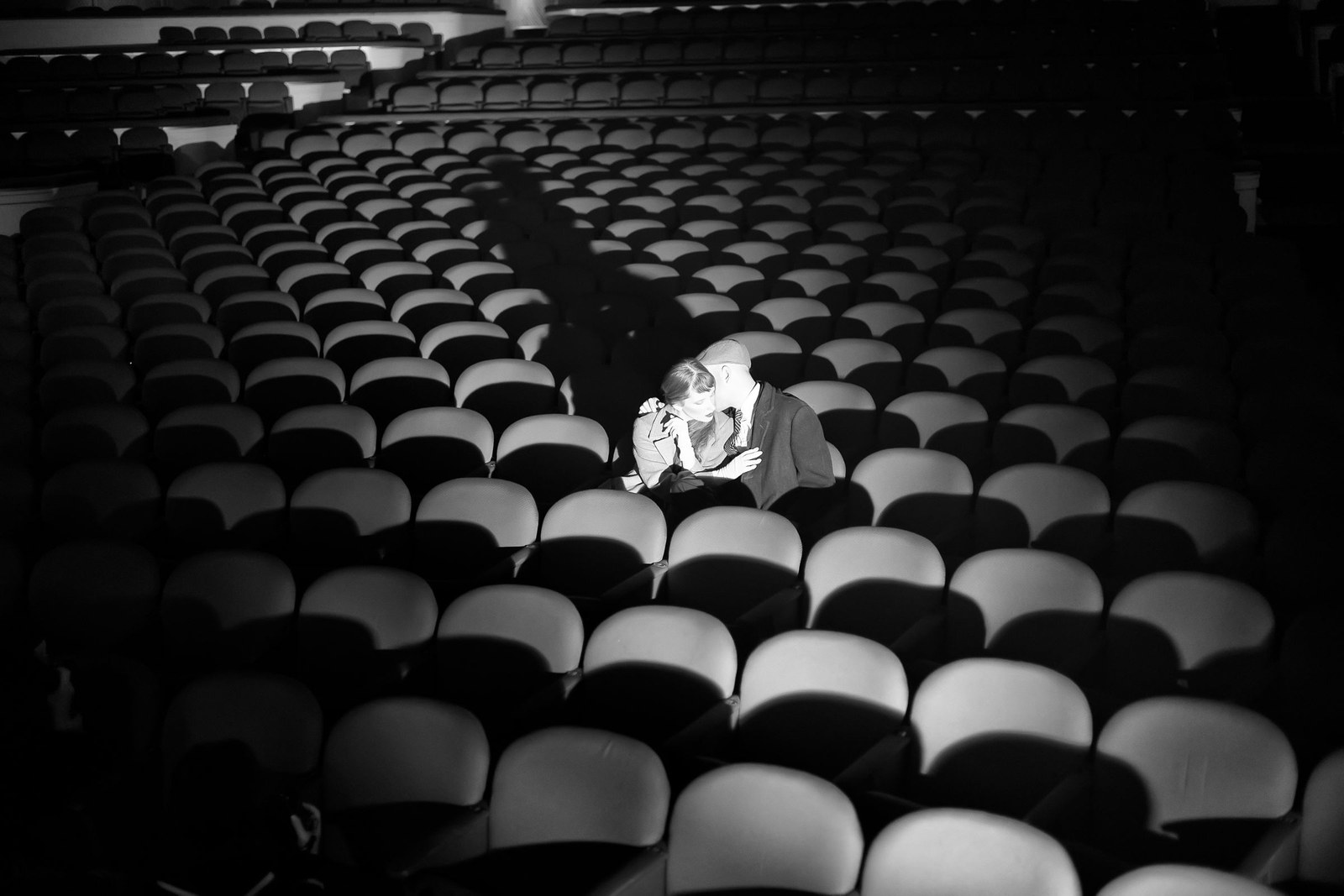
Here is where the analogy earns its keep. The super objective isn’t about this photograph at all. It belongs to the thing all of the photographs are part of, and the question it puts to any single frame is not what is this picture trying to do. It is what is this picture doing for the larger thing.
Most of us never actually ask that one. We have a folder of good single photographs and nothing joining them. Each one had an objective and met it. Line forty of them up and they say very little, because forty objectives pointing in forty directions isn’t a body of work. It’s a contact sheet with good light on it.
A super objective sounds grander than it is. It isn’t a mission statement and it doesn’t need to be noble. To show that the town I grew up in is still standing. To prove these people are not what the news says they are. To work out why I keep going back to the same half mile of coast. Any one of those will organize years of work, and none of them would embarrass you to say out loud.
Once it has been named it starts doing something practical, and it works in both directions. It tells you which of the hundred things in front of you is actually worth raising the camera for. It also tells you which of your good photographs doesn’t belong in the set, which is the harder half and the reason sequencing a portfolio is so painful without one.
This is not the same thing as style
Worth separating, because we have argued something that sounds contrary and both things are true at once. Style can’t be chosen. It accumulates out of a few hundred small decisions made at speed and it shows up whether you want it to or not, the way handwriting does.
A super objective is a different layer entirely. An actor doesn’t choose their voice, their timing or the way they carry themselves across a room. Those are theirs and they turn up in every part they ever play. What they do choose, deliberately, is what the character is after. Style is how. The super objective is what. Confusing the two is why find your style is such useless advice, because it asks you to decide the one thing you can’t decide while leaving the one thing you can completely untouched.
What to do with this on the next walk
The small question is probably already being asked, even if the answer arrives as a feeling rather than a verb. The large one usually isn’t, and the honest reason is that naming it feels presumptuous while the work is still forming. It genuinely isn’t. Actors are expected to revise a super objective all the way through rehearsal, and most arrive at the real one somewhere in the middle rather than on the first read. A provisional answer you keep changing is worth considerably more than no answer at all, because only the provisional one can actually steer anything.
So ask the small question in front of the subject, in verbs, the way you always have. Then ask the second one, which is simply what this frame is a vertebra of.
If nothing comes back, that’s the finding. It means the spine hasn’t been named yet, and every photograph in the folder is holding itself up on its own.