Nobody else has to be six kinds of photographer before lunch, with no second takes.
There’s a quiet snobbery in photography about wedding work. It gets filed under commercial, which in certain circles is a polite way of saying it doesn’t count.
It’s worth looking at what the job actually demands, because by almost any technical measure it’s the hardest day’s work in photography, and a lot of what it teaches transfers straight into the kind of pictures most of us make for nobody but ourselves.
Six genres before the cake is cut
Run through what a wedding photographer is expected to deliver in a single day.
Still life, because the rings and the shoes and the invitations have to look like a catalogue shot. Architecture, because somebody has to make the venue look like somewhere worth being. Portraiture, both posed and candid, of people who are not models and who are nervous. Group work, which is logistics as much as photography. Photojournalism through the ceremony. Low light reportage once the dancing starts.
Six disciplines, each of which someone else has built an entire career on, all of them inside about twelve hours.
A white dress and a black suit in the same frame
Here is the part that should interest anyone working in black and white, because it’s our problem in its purest form.
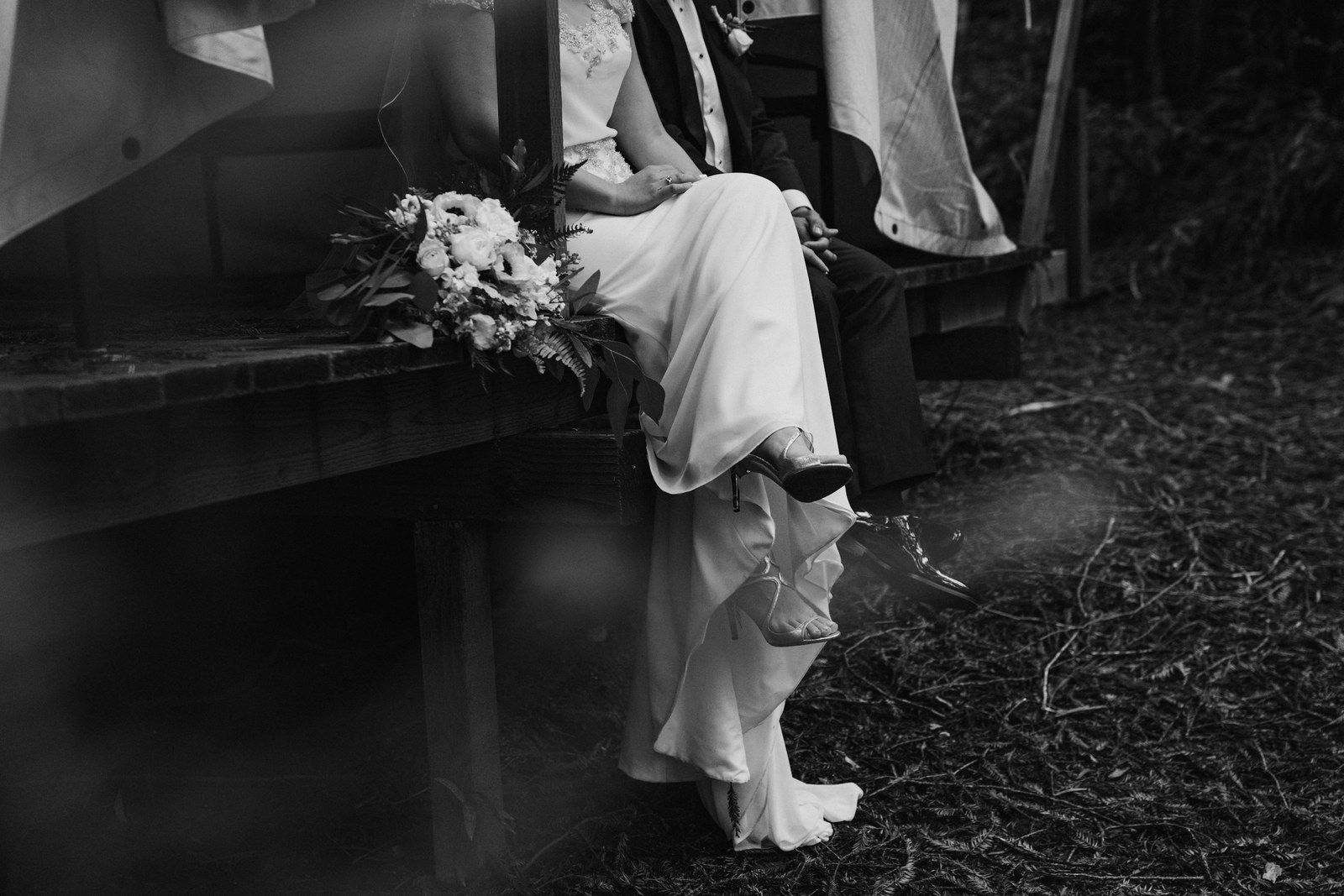
A wedding puts the brightest thing you will photograph all year directly against the darkest thing you will photograph all year, touching, in the same light. Satin that blows to paper white if you breathe on it, beside a suit that blocks up into a shape with no detail at all. Then you are asked to hold texture in both.
That’s the whole discipline of tonal control, compressed into one frame, with a client waiting. Everything we write about deciding where the picture sits on the tonal scale is theory until you have to do it on a dress and a dinner jacket at the same time.
The light changes every forty minutes and none of it is yours
A landscape photographer waits for the light. A studio photographer builds it. A wedding photographer gets handed whatever is there and has about four minutes to deal with it.
Morning preparations in a hotel room lit by one window and a ring light somebody brought. A church that is four stops darker than the doorway behind it, where flash is often banned outright. Group shots at one in the afternoon under a sun directly overhead, which is the worst light of the day and not negotiable because that’s when the schedule says. A reception running on tungsten, daylight through the windows and coloured LED uplighting, all at once. Then a dance floor lit by whatever the DJ bought.
Each of those is a different exposure and white balance problem, and the gaps between them are measured in minutes.
Which is one honest reason so much of it ends up monochrome
Mixed light is close to unfixable in colour. Tungsten and daylight and a purple uplighter in one frame give you skin in three different casts, and the corrections fight each other.
Take the colour away and the problem stops existing. This isn’t a stylistic affectation when a wedding photographer does it, it’s often the most practical route to a usable picture, and it’s the same reason monochrome holds up at night when colour falls apart into noise and strange casts.
There is no second frame
This is the bit that changes how a person works, and it’s the hardest thing to simulate if you’ve never had to do it.
The first kiss happens once. The father’s face as she comes down the aisle happens once. You cannot ask anyone to walk back and do it again, and if the camera was on the wrong setting the moment is simply gone and somebody paid for it.
What that produces is a specific kind of discipline. Settings dialled before the thing happens rather than during it. Focus already set to roughly the right distance. A second body on the other shoulder with a different lens so there’s no changing glass at the critical moment. Two cards recording at once. Batteries counted.
Most of us never work under that pressure, and our photography is quietly worse for it.
The lesson is range, and it is not optional
If you never photograph a wedding in your life, this is still the thing to take from it.
Most of us pick a lane early. We decide we’re a street photographer or a landscape photographer, and after a few years we call the result a style. The wedding photographer is denied that. They have to be competent at six things by Saturday, and the uncomfortable truth is that having to cover all six doesn’t dilute any of them. It makes each one better.
Every genre is solving the same problems under different pressure
That is why the skills carry across, and it is worth being specific about how.
Still life is the study of how light falls on a surface, which is landscape work seen from two feet away instead of two miles. Photographing a group of eight is controlling a frame with eight things happening in it, which is precisely what a busy street demands and almost nothing else teaches. Directing a nervous stranger for ninety seconds is the whole difference between an approached portrait that works and one that dies of awkwardness. A dim church where flash is banned is the same problem as a street at midnight, with a deadline attached.
The pressure is the point. We learn a thing faster where the penalty for getting it wrong is immediate. Holding detail in a white dress and a black suit at the same time will teach somebody more about tonal control in one afternoon than a year of landscapes will, because the landscape forgives you and the client does not.
So the skill comes home sharper than it would have done if you had tried to learn it in your own comfortable genre.
What you can learn from wedding photographers
Go and work outside your own genre on purpose. That is the whole of it, and it is worth saying exactly what it gives back.
Photograph people for a while and your street work stops being taken from the far side of the road. The thing you pick up isn’t a technique, it’s the nerve to be close and the few sentences that make somebody comfortable, and once you have those the pictures change completely.
Spend a month on still life and your landscapes get cleaner, because an hour spent moving one object around a table until the background stops interfering is an hour of learning to see everything that is not the subject. Shoot an event and you start reading a scene two minutes ahead instead of reacting to it. Make yourself work in light you would normally refuse and you stop being a photographer who can only operate for forty minutes a day.
There is a reason it works faster outside your own lane. Inside it you have already decided what is allowed, and those decisions are invisible to you now because they feel like taste. Somewhere unfamiliar you have no habits to defend, so you notice the conventions you had stopped seeing at home, and you come back able to break a few of them on purpose.
You don’t have to be any good at it, and nobody needs to see the results. A month on the genre you would never pick is enough. Whatever you drag back turns up in your own work within weeks, and by then it feels like your own idea rather than something borrowed.
Their work looks easy for one reason. They can already do the six things the rest of us are still choosing between.